
In the early 1960s, Danish designer Verner Panton observed a stack of plastic buckets — how they nested perfectly, each identical, each supporting the weight of the next. From that observation grew one of the most influential furniture designs of the 20th century: the Panton Chair, the world's first single-piece injection-moulded plastic chair.
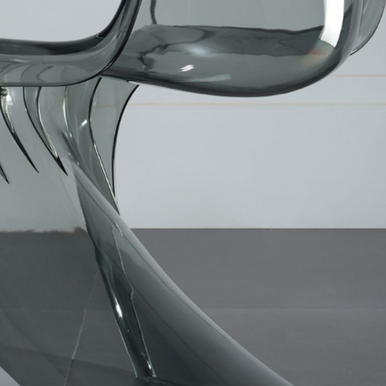
The Panton Acrylic Stool at Linear Furnishings Singapore carries the visual DNA and design philosophy of Panton's revolutionary approach to form, material, and colour.
Verner Panton: The Enfant Terrible of Danish Design
Born in 1926 in Gamtofte, Denmark, Verner Panton studied at the Royal Danish Academy of Arts in Copenhagen, graduating in 1951. His first professional years were spent in the office of Arne Jacobsen — but where Jacobsen refined the Scandinavian tradition, Panton was already plotting to explode it.
Panton's design philosophy was deliberately provocative. 'The main purpose of my work is to provoke people into using their imagination,' he said. 'Most people spend their lives housed in dreary, grey-beige conformity, mortally afraid of using colours.' This was not merely aesthetic preference but a genuine conviction that design had a responsibility to challenge the limitations people imposed on their own environments.
The S-Chair: Years of Experimentation
The Panton Chair — officially an S-chair, named for its continuous S-shaped profile — was not a sudden inspiration but the product of over a decade of obsessive experimentation. Panton first explored the concept in the mid-1950s, attempting to create a single cantilevered seat from a single material. He tried plywood in 1956. He tried fibreglass. He tried polyester. The technical challenge was enormous: a single continuous form that could bear the weight and dynamic loads of a seated person, produced from a material that could be injection-moulded at scale.
It was only through collaboration with Willi Fehlbaum at Vitra — who agreed to invest in the chair despite significant technical uncertainty — that the first production version emerged in 1967. The chair was hailed as revolutionary and received numerous international design awards upon its release.
Panton Acrylic Stool Chair Modern Style — SGD 287 with free delivery to your doorstep at Linear Furnishings Singapore
The Design Revolution: One Material, One Form, One Piece
What made the Panton Chair genuinely revolutionary was its rejection of every conventional furniture construction principle simultaneously:
- No joints: Conventional furniture assembles multiple components — legs, seat, back, frame. The Panton Chair is one continuous piece. There is nothing to assemble, nothing to loosen, nothing to fail at a joint.
- No legs: The cantilevered S-form distributes load through the continuous curve rather than through vertical supports — a structural principle borrowed from architecture
- Stackable: The original inspiration — those nested buckets — was realised: Panton Chairs stack directly on each other, a feature that emerged directly from the single-piece geometry
- Colour as philosophy: Panton embraced colour as a fundamental design element, not decoration. The chair came in saturated, confident colours that asserted that furniture could be joyful
Transparent Acrylic: Panton's Colour Philosophy in a New Material
The Panton Acrylic Stool extends Panton's material exploration into transparent acrylic — a material that takes his preoccupation with colour and light to its logical extreme. In Panton's early days, an insatiable hunger for experimentation resulted in designs composed of then-iconoclastic materials such as plastic, steel, plexiglass, and even foam rubber.
Transparent acrylic in the S-chair form achieves something Panton would have appreciated: the structural logic of the form is completely visible. There is no surface to conceal the engineering — the curve that makes the cantilever work is displayed rather than hidden.
Frequently Asked Questions
Is the Panton S-chair comfortable without cushioning?
The Panton Chair's ergonomic form — the S-curve was designed to follow the spine's natural profile — provides adequate comfort for dining and casual seating durations. The curve distributes weight across the back and seat rather than concentrating it at specific pressure points. For extended seating, a seat pad can be added without compromising the aesthetic. The Panton Acrylic Stool at Linear Furnishings is appropriate for bar and counter height use.
How durable is acrylic furniture in Singapore's climate?
Quality acrylic (PMMA) performs well in Singapore's indoor conditions. It is not affected by humidity and maintains dimensional stability across Singapore's temperature range. UV exposure can cause yellowing over time in direct sunlight — position acrylic furniture away from prolonged direct sun exposure. Acrylic scratches more readily than polycarbonate — wipe with a soft microfibre cloth and avoid abrasive cleaners. Minor scratches can be polished out with plastic polish.
What height should a bar stool be for a Singapore kitchen counter?
Standard Singapore kitchen counter height is 90cm; bar stool seat height should be 60-65cm, leaving approximately 25-30cm between the counter surface and seat. For kitchen islands at 105cm (island height), specify counter-height stools at 75-80cm seat height. Always confirm your counter height before ordering — the wrong seat height makes a stool uncomfortable regardless of its design quality.