
Velvet has been a luxury upholstery material since the Renaissance — its pile structure creates a surface that absorbs and reflects light differently as viewing angle changes, producing a depth and richness that no other textile can replicate. Its return to prominence in contemporary Nordic furniture design is not nostalgia but a deliberate response to the visual fatigue of minimal hard surfaces that defined early-2000s interior design.
The Odin Velvet Lounge Chair at Linear Furnishings Singapore participates in this design tradition — bringing the sensory richness of velvet into the clean geometric language of Nordic lounge seating.
Arne Jacobsen and the Upholstered Nordic Icon
Arne Jacobsen — the Danish architect who also designed the Egg Chair (1958), the Swan Chair (1958), and the Drop Chair (1958) — demonstrated that the most rigorous geometric forms became more human when covered in rich upholstery. The Egg Chair's sculptural fibreglass shell, fully upholstered in fabric or leather, achieved something that neither material alone could produce: the structural precision of modernism combined with the sensory comfort of traditional upholstered furniture.
Jacobsen's upholstered chairs established a principle that Nordic furniture design has followed since: that the relationship between structural form and surface material is not hierarchical (form first, material second) but simultaneous — the right material does not decorate the form but completes it.
The Velvet Revival in Nordic Design
The contemporary return of velvet in Nordic furniture design — which began approximately around 2015 and has continued since — responds to a specific visual problem. By the early 2010s, the dominant interior aesthetic of exposed concrete, white walls, light wood, and metal had become pervasive enough to feel cold. Velvet offered what nothing else could: warmth without mass, richness without complexity, colour without pattern.
Contemporary performance velvet addresses the practical objections that historically limited velvet's use:
- Performance treatment: Modern velvet for furniture uses treated fibres that resist the pile flattening (crush marks) that made traditional velvet high-maintenance
- Stain resistance: Performance velvet finishes allow surface moisture to bead rather than penetrate — making spills manageable rather than catastrophic
- Colour stability: Solution-dyed performance velvet maintains colour in UV exposure — relevant in Singapore where light enters rooms at varying angles throughout the day
- Cleanability: Code W (water-cleanable) performance velvet can be spot-cleaned with mild soap and water — a practical requirement for Singapore's climate
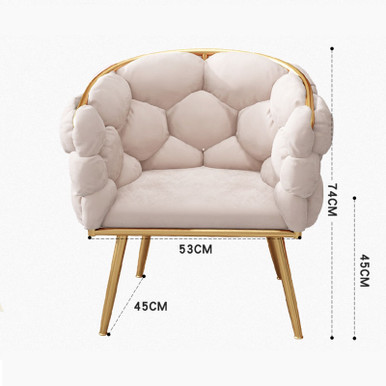
Odin Velvet Lounge Chair Nordic Style — SGD 219 with free delivery to your doorstep at Linear Furnishings Singapore
Velvet in Singapore Interiors: The Case for Richness
Singapore's interior design has historically leaned toward practical, easy-maintenance surfaces — a rational response to the climate. But the visual quality of an interior is itself a quality-of-life factor, and the distinctive way velvet interacts with light produces an interior atmosphere that harder, flat surfaces cannot achieve.
A velvet lounge chair in a Singapore living room:
- Creates a visual anchor — the chair reads as a deliberate design choice rather than incidental furniture
- Introduces texture contrast with the smooth surfaces (tile, marble, glass) that dominate Singapore interiors
- The colour appears different under artificial evening lighting versus natural morning light — creating visual dynamism from a single piece
- Provides a tactile quality that invites occupation — the chair feels welcoming rather than merely functional
Frequently Asked Questions
How do you maintain a velvet chair in Singapore's humid climate?
For Singapore conditions: vacuum weekly with a soft upholstery attachment to prevent dust from becoming embedded in the pile. For the velvet surface, brush regularly with a soft clothes brush in the direction of the pile to maintain its appearance. In the event of spills, blot immediately — do not rub. Use a slightly damp cloth for spot cleaning, then allow to dry naturally in a well-ventilated space. Performance velvet handles Singapore's humidity well in air-conditioned rooms; avoid placing velvet furniture in non-air-conditioned spaces where sustained high humidity can promote pile matting.
What colours work best for a velvet lounge chair in Singapore interiors?
For Singapore's typically neutral interiors (white, grey, beige walls; light wood or grey tile floors): jewel tones (deep teal, forest green, dusty rose, midnight blue) create the strongest visual impact — a single velvet piece in a strong colour elevates the entire room. For more cautious approaches, earthy neutrals (burnt orange, terracotta, camel, sage) add warmth without assertive contrast. Avoid pale neutrals in velvet (cream, light grey) which show marks more readily and don't exploit velvet's distinctive light-catching properties.
Is velvet appropriate for a Singapore home with children or pets?
Performance velvet with stain-resistant treatment handles the practical realities of family life better than standard velvet. Liquid spills bead on the surface and can be blotted before penetration. For pet owners, velvet does attract pet hair — a lint roller and weekly vacuuming manage this effectively. For homes with young children, microfibre or performance fabric may be more practical, though performance velvet is a reasonable choice for living rooms where children's activity is managed.