
In 1973, French designer Michel Ducaroy stood at his bathroom sink, staring at a tube of toothpaste folded back on itself. In that mundane moment, one of the most radical furniture designs of the 20th century was born — a floor-hugging sofa made entirely of foam, with no frame, no legs, no conventional structure. It would go on to sell over 1.5 million units across 72 countries over five decades.
The Cater Lounge Chair at Linear Furnishings Singapore draws its design DNA from this revolutionary moment in furniture history.
Michel Ducaroy: The Sculptor Who Changed How We Sit
Born in 1925 into a family of French furniture manufacturers, Ducaroy studied sculpture at the École Nationale Supérieure des Beaux-Arts in Lyon — not furniture design, not architecture, but sculpture. This foundation profoundly shaped everything he created. In 1954, he began working with Ligne Roset, the French manufacturer that would become his creative home for the rest of his career.
Through the 1960s, Ducaroy pushed technological boundaries with pieces like the Adria (1968) — the world's first self-supporting all-foam chair. But it was one evening in 1973 that everything changed.
The Toothpaste Tube That Inspired a Design Icon
Ducaroy observed his toothpaste tube, folded back on itself, and saw in its crumpled form the silhouette of a sofa — 'like a stovepipe closed at both ends.' The sketch he made that evening became the TOGO. What made TOGO genuinely revolutionary was its complete abandonment of conventional furniture structure:
- No frame, no legs: The sofa's structure comes entirely from triple-density polyurethane foam — the material is the structure
- Floor-level geometry: The low profile was a structural necessity — the foam's integrity required it to sit wide and close to the ground
- Ruched fabric: The characteristic wrinkled surface emerged from stretching the covering over the organic foam form — creating a deliberately human quality
- Ergonomic embrace: Ducaroy's sculptural training meant every curve was designed to follow the human body rather than geometric convention
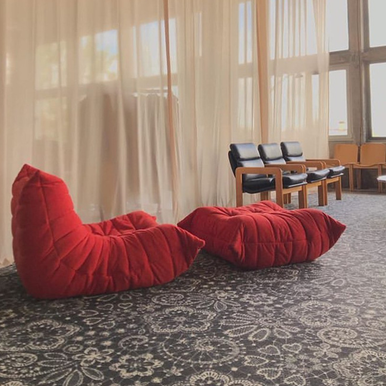
Cater TOGO Fabric Seat Lounge Chair — SGD 170 with free delivery to your doorstep at Linear Furnishings Singapore
Design Philosophy: Ergonomics Meets Organic Form
Ducaroy's design philosophy combined ergonomics and comfort with high-tech synthetic materials. The TOGO embodied a generational shift — when unveiled at the Home Economics show in 1973, it was met with skepticism. 'The main shock was that it had no base,' recalled Antoine Roset. It was seen as too radical, too casual. Within years, it had become the symbol of a relaxed, non-conformist generation's relationship with domestic space.
Fifty years on, TOGO remains in continuous production by Ligne Roset — celebrating its 50th anniversary in 2023. The design principles that made it radical are precisely what make TOGO-inspired furniture well-suited to contemporary Singapore living: the low profile maximises the sense of space, the organic form provides visual relief from rectilinear geometry, and the all-foam construction adapts naturally to the body.
Frequently Asked Questions
Is TOGO-style furniture suitable for Singapore's climate?
Yes — the all-foam construction performs well in Singapore's conditions. There is no wooden frame to absorb moisture and warp, and polyurethane foam is relatively moisture-resistant. The low-profile design also promotes air circulation beneath the seating area. Pair with a performance fabric cover for maximum longevity in Singapore's humidity.
What makes TOGO-style different from conventional sofas?
Conventional sofas use a frame as the structural element with cushioning added over it. TOGO-style designs use foam as both structure and comfort — there is no frame. Triple-density polyurethane foam is shaped and covered to create a self-supporting form. This produces a lighter, more organic sitting experience that conforms to the body differently from frame-based designs.
How durable is the Cater Lounge Chair?
The Cater's all-foam construction with quality fabric cover provides good durability for regular home use. For Singapore's climate, performance fabric or microfibre covers outlast standard polyester — choose accordingly based on your usage intensity.