
In 1963, Hans Wegner designed a chair that looked as though it had been found on a beach rather than manufactured in a workshop. The Shell Chair (CH07) — a continuous scoop of curved wood suggesting a cockleshell, supported on three angled legs — was immediately recognised as one of the most purely resolved chair designs of the 20th century. The Vilda Rattan Shell-Shaped Chair at Linear Furnishings Singapore draws on this sculptural tradition.
Hans Wegner and the Shell Chair: Sculpture as Seating
By 1963, Hans Wegner had already designed over 200 chairs. The Wishbone, the Round Chair, the Peacock — each one a landmark. The Shell Chair represented a different ambition: rather than refining the traditional four-legged chair form, Wegner asked what would happen if back, seat, and armrests were treated as one continuous organic surface.
The Shell Chair's revolutionary feature is that its back and seat are a single, uninterrupted form — a curved shell that cradles the body from sitting bones to shoulder blades. There is no joint between seat and back, no structural interruption — just a continuous surface shaped to the human body's sitting posture.
The three-legged design — two front legs and one rear — was not arbitrary but structural: three points always define a plane, meaning the chair never wobbles regardless of floor unevenness. It is also, visually, the minimum number of legs — any fewer and the shell would fall.
Organic Form in Chair Design: The Body as Blueprint
The shell chair form — whether in wood, fibreglass, rattan, or plastic — represents a specific design philosophy: that the ideal chair form is derived from the human body rather than from geometric convention. This philosophy connects Wegner's Shell Chair (1963) to Eero Saarinen's Womb Chair (1948), to Charles and Ray Eames' fibreglass shell chairs (1950), and to the entire tradition of organic furniture design that challenged the rectilinear dominance of conventional furniture construction.
Key characteristics of the shell chair design language:
- Continuous surface: The shell wraps from seat through back without interruption — one form rather than assembled components
- Organic curves: The form follows the body's geometry rather than geometric convention — curves where the body curves, support where the body needs support
- Visual lightness: Despite providing full back support, shell chairs appear to float — the minimal structure beneath the shell creates a sense of levitation
- Material expression: The shell form works in different materials — wood, fibreglass, rattan, plastic — each expressing the same organic principle through different material properties
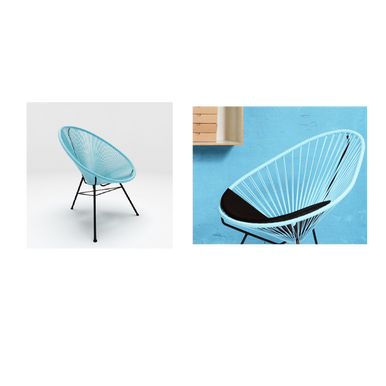
Vilda Rattan Shell-Shaped Chair (2 Pieces) — SGD 680 with free delivery to your doorstep at Linear Furnishings Singapore
Rattan Shell Chairs: Material Intelligence
Applying the shell chair form to rattan adds a dimension that wood and fibreglass cannot provide: textural richness and material warmth at the scale of the complete shell surface. Rattan weaving follows the shell's curves naturally — the material bends to the form, revealing the form through its texture rather than obscuring it.
For Singapore interiors, the rattan shell chair brings together three design traditions simultaneously: the organic form philosophy of mid-century Scandinavian design, the material intelligence of Southeast Asian rattan craft, and the visual lightness that Singapore's compact spaces benefit from.
Frequently Asked Questions
Is a shell chair comfortable for extended sitting?
The shell chair form is designed for postural support — the continuous surface that extends from seat through back ensures the spine is supported across its full length, not just at the lumbar. For dining (30-90 minutes), shell chairs are excellent. For extended desk work (3+ hours), a chair with more adjustable lumbar support is preferable. The Vilda Rattan Shell Chair is ideal for dining rooms, reading corners, and casual seating areas.
Why do some shell chairs have three legs and others four?
Three-legged shell chairs (like the original Wegner CH07) are structurally logical: three points always define a plane, so the chair is inherently stable on any surface. Four-legged versions offer more floor-plan flexibility but require precise levelling on uneven floors. For Singapore's typical flat tile and marble floors, both configurations perform equivalently. The visual difference is significant: three legs appear more sculptural and minimal; four legs appear more conventional and grounded.
How does the Vilda Rattan Shell Chair pair with other furniture?
Rattan shell chairs work particularly well with: wooden dining tables (shared natural material language), marble and stone surfaces (warm organic vs cool hard surface contrast), and mixed-material interiors. In Singapore, the Vilda pairs naturally with the growing Japandi trend — Japanese minimalism combined with Scandinavian functionality — and with coastal modern styles that are increasingly popular in Singapore condo interiors.