
In 1919, architect Walter Gropius founded a school in Weimar, Germany with a radical proposition: that art, craft, and industrial production should not be separate disciplines but one integrated practice. The Bauhaus — it lasted only 14 years before the Nazi government closed it in 1933 — produced more influential design ideas per year than almost any institution in history. The Bauhaus Armchair at Linear Furnishings Singapore carries the name and philosophy of this movement.
What Bauhaus Actually Meant
'Bauhaus' means 'building house' — a deliberate inversion of the German word for house construction (Hausbau). The name announced the school's ambition: to rebuild the relationship between making things and using them. The core conviction was that the distinction between 'fine art' and 'applied craft' was false — a painting and a chair were both designed objects, and both should be subject to the same rigorous thinking about purpose, material, and form.
The Bauhaus design principles that shaped 20th-century furniture and architecture:
- Form follows function: A chair's form should emerge from what a chair needs to do — support the human body — not from decorative convention
- Truth to materials: Materials should not imitate other materials. Steel should look like steel; wood should look like wood
- Industrial production: Good design should be reproducible at scale — accessible to the many, not reserved for the wealthy
- Less is more: Mies van der Rohe's phrase captured the Bauhaus aesthetic — complexity eliminated until only what is necessary remains
Marcel Breuer and the Bicycle Handlebar Revelation
Of all the furniture to emerge from the Bauhaus, Marcel Breuer's tubular steel chairs represent the movement's principles most completely. Breuer arrived at the Bauhaus as a student in 1920 and became head of the furniture workshop by 1925 — an extraordinary trajectory for a 23-year-old.
The revelation came from his bicycle. Breuer noticed that the tubular steel handlebars were simultaneously strong, lightweight, and elegantly formed — and that the same material could be applied to furniture. The result was the Wassily Chair (Model B3, 1925): a club chair reduced to its structural essence — a continuous bent steel tube supporting leather or canvas straps that formed the seat, back, and armrests. Wassily Kandinsky, Breuer's colleague at the Bauhaus, admired it so much that Breuer made him a copy. The chair bears Kandinsky's name to this day.
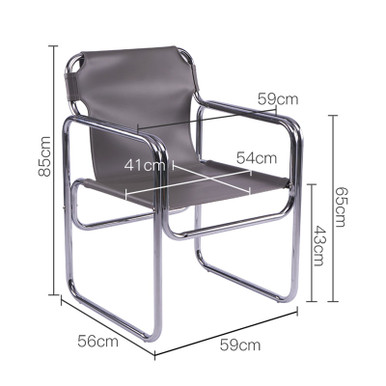
Bauhaus Armchair — SGD 199 with free delivery to your doorstep at Linear Furnishings Singapore
The Bauhaus Chair in Singapore Interiors
The Bauhaus aesthetic — clean geometry, honest materials, functional clarity — translates directly to contemporary Singapore interior design. The movement's rejection of decorative excess aligns with the minimalist approach that dominates Singapore's HDB and condo interiors, and its emphasis on industrial production means that Bauhaus-inspired designs are available across a wide price range.
The Bauhaus Armchair's geometric form and structural transparency make it one of the most versatile pieces in contemporary interior design:
- Works with contemporary, Scandinavian, industrial, and minimalist interior styles
- The visible steel structure adds visual interest without visual weight
- The geometric precision of Bauhaus design ages well — it does not become dated
- The human-centred ergonomic philosophy means comfort is built into the form, not added through excessive cushioning
Frequently Asked Questions
What is the difference between Bauhaus design and Scandinavian design?
Both movements emphasised functional, minimal design without unnecessary decoration, but from different starting points. Bauhaus (Germany, 1919-1933) was primarily concerned with integrating industrial production with design — its aesthetic was urban, geometric, and industrial. Scandinavian design (Denmark, Sweden, Norway, 1950s-1960s) integrated craft traditions with industrial production — its aesthetic was warmer, organic, and material-sensitive. Both traditions heavily influence contemporary Singapore interior design.
Is Bauhaus furniture still being produced today?
Yes — several Bauhaus designs remain in continuous production. Marcel Breuer's Wassily Chair is produced by Knoll. Ludwig Mies van der Rohe's Barcelona Chair is also produced by Knoll. Marcel Breuer's Cesca Chair (B32) is produced by Knoll and multiple licensees. The continued production of these 1920s designs reflects their genuine functional and aesthetic quality.
What interior styles work best with a Bauhaus armchair?
Bauhaus armchairs work particularly well with: contemporary minimalist (the geometric forms complement clean-lined interiors), industrial (the steel frame references industrial architecture), mid-century modern (Bauhaus was the precursor to mid-century design), and Japandi (both movements share an emphasis on functional simplicity and honest materials). In Singapore's clean-lined HDB and condo interiors, Bauhaus pieces add visual structure without visual clutter.