
A sofa's external appearance tells you almost nothing about whether it will maintain its structural integrity for five years or fifteen. The frame and spring system — entirely hidden beneath upholstery — are what determine this. In Singapore's climate, where untreated wood absorbs moisture and metal components face accelerated corrosion, understanding what is inside your sofa before you buy it is more important than it might appear.
The Frame: Your Sofa's Skeleton
Hardwood vs Softwood vs Engineered Wood
| Frame Material | Singapore Performance | Expected Lifespan | Notes |
|---|---|---|---|
| Kiln-dried solid hardwood (oak/beech/maple) | Excellent | 20+ years | Best investment — can be reupholstered indefinitely |
| Kiln-dried rubberwood | Very good | 12-18 years | Southeast Asian species — excellent tropical humidity adaptation |
| Quality plywood (7+ layers) | Good — dimensionally stable | 10-15 years | Resists warping better than solid softwood |
| Kiln-dried softwood (pine) | Moderate | 6-10 years | Acceptable if kiln-dried; prone to warping if not |
| Non-kiln-dried wood | Poor | 3-7 years | Absorbs Singapore's humidity → warps → frame loosens |
| MDF/Particleboard | Very poor | 2-5 years | Expands in humidity, screws lose grip — avoid entirely |
Frame Joinery: How Pieces Are Held Together
A frame can use excellent wood and still fail quickly if the joints are inadequately constructed. The joinery method is the second most important structural variable after wood species.
| Joint Type | Strength | Singapore Durability | Indicator |
|---|---|---|---|
| Mortise & tenon + wooden dowels + glue | Strongest | 20+ years | Traditional craftsmanship — premium standard |
| Dowel joints + glue + screws | Very strong | 15+ years | Good modern construction |
| Corner blocks (triangular reinforcement) | Adds 30-50% to joint strength | Adds 5+ years | Look inside corners — good sofas always have these |
| Screws + glue only | Moderate | 8-12 years | Acceptable for mid-range |
| Staple gun only | Weakest | 2-4 years | Budget construction — joints loosen within years |
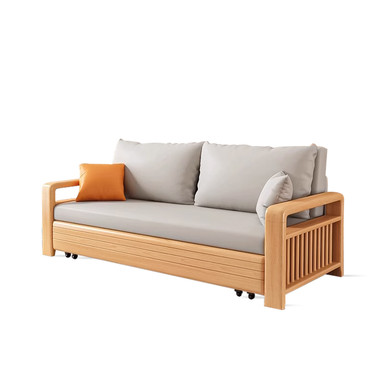
Mia Wooden Foldable Sofa Bed with Armrest Modern Style -- from SGD 1218.9 with free islandwide delivery at Linear Furnishings Singapore
Updated May 2025 -- Browse our sofa bed range
Spring Systems: What Supports You
8-Way Hand-Tied Coil Springs: The Heritage Standard
The 8-way hand-tied system uses individual hourglass coil springs, each individually tied to its neighbours and the frame with natural twine in eight directions — front-to-back, side-to-side, and diagonally in both planes. The result is a spring system where each coil responds independently to load, providing the most nuanced and supportive sitting experience available in upholstered furniture.
This construction requires skilled craftsmen and typically doubles the production time for the spring installation step alone. Sofas using genuine 8-way hand-tied construction are typically priced at SGD 3,000 and above in Singapore — the labour cost is substantial. When a retailer claims 8-way hand-tied construction on a SGD 1,200 sofa, question the claim carefully.
Sinuous/Serpentine Springs: The Modern Standard
Sinuous springs — continuous S-shaped steel wires stretched front-to-back across the seat frame — became the dominant residential sofa spring system from the mid-20th century because they reduce material and labour cost by 60-80% versus coil springs while providing adequate support for most users.
Quality sinuous spring systems specify:
- Wire gauge: Heavier gauge wire (9-gauge or thicker) provides firmer, more durable support. Light-gauge wire (11-gauge) is cheaper but deflects more under load.
- Spring spacing: Wires spaced 4-6 inches apart provide even support. Wider spacing (8+ inches) creates unsupported zones that feel uneven.
- Cross-ties: Lateral tie wires connecting adjacent sinuous springs front-to-back prevent individual springs from spreading under load — a critical quality indicator.
- Attachment method: Springs clipped to hardwood frames with metal clips perform better than springs stapled to softer wood.
Elastic Webbing: The Budget Foundation
Many mid-market and budget sofas use interwoven elastic webbing instead of springs as the seat foundation. This allows very thin seat profiles (popular in modern design) and dramatically reduces production cost. The limitation: elastic webbing has a defined stretch fatigue life — typically 3-7 years before the webbing loses tension and the seat begins to sag noticeably.
Polypropylene webbing (plastic composition) performs better than jute webbing (plant-based) in Singapore's humidity. Jute webbing degrades in tropical moisture conditions within 2-4 years.
Sofa Legs and Hardware: The Often-Forgotten Details
| Leg Material | Singapore Performance | Notes |
|---|---|---|
| Solid hardwood stained/lacquered | Excellent | Refinishable, humidity resistant with proper finish |
| Solid metal (stainless steel) | Excellent | No corrosion, modern aesthetic |
| Chromed steel | Good | Chrome prevents corrosion — inspect for chips in chrome coating |
| Painted softwood | Moderate | Paint delays but doesn't prevent moisture absorption |
| Plastic legs | Poor appearance over time | UV and humidity cause yellowing and brittleness |
Frequently Asked Questions
How do I test a sofa's frame quality in a showroom?
Four quick tests: (1) Lift one corner — quality sofas with hardwood frames and spring systems are heavier than budget equivalents. (2) Sit in the far corner — you should feel solid support to the very edge. (3) Gently rock the sofa back and forth — zero movement indicates quality joinery. (4) Look under the sofa or feel inside — corner blocks (triangular wooden reinforcements) at frame joints indicate quality construction.
Is a sofa with sinuous springs better than one with elastic webbing?
Yes, for longevity. Sinuous springs (correctly specified with adequate wire gauge and cross-ties) maintain their support properties for 10-15 years. Quality elastic webbing may last 5-7 years before losing tension. The operational difference is not always apparent when the sofa is new, but becomes clear as the sofa ages.
Can sofa frame joints be repaired if they loosen?
Yes — hardwood frames with screw-and-glue joints can be re-glued and reinforced. This is much easier and cheaper than replacing the sofa. Staple-only budget frames cannot be effectively repaired. MDF frames that have expanded from moisture absorption cannot be restored. This is why the initial frame material and joinery choice determines whether your sofa has a 10-year repair-possible lifespan or a 3-year throw-away lifespan.