
Updated May 2025 -- All material specifications verified. Browse our director table range
Sintered stone director tables represent the current engineering pinnacle of office desk desktop materials. In Singapore's demanding tropical environment, the properties that define sintered stone — complete impermeability, extreme hardness, thermal resistance, and zero organic content — directly address every performance limitation of wood-based, glass, and marble alternatives. This guide examines the material science behind sintered stone and explains why it is the rational choice for Singapore executives who want performance alongside aesthetics.
What Sintered Stone Is: The Manufacturing Process
Sintered stone is manufactured by dry-pressing a formulation of natural mineral materials — primarily feldspars, silica sand, natural clays, natural mineral pigments, and in some formulations, porcelain materials — at extreme pressure (30,000–50,000 tonnes force on large-format slabs) and sintering the compressed powder at 1,200–1,250°C in continuous kiln systems.
The sintering process causes solid-state diffusion between particles — atoms migrate across particle boundaries, forming direct chemical bonds between adjacent mineral particles. The result is a homogeneous, dense mineral matrix with essentially no porosity, no organic content, and properties approaching those of natural granite.
| Sintered Stone Property | Value | Engineering Explanation |
|---|---|---|
| Water absorption | <0.05% (typically <0.01%) | Sintered mineral matrix has no continuous porosity — no path for water ingress |
| Mohs hardness | 6–7 (comparable to quartz) | Silica minerals form the hard matrix — granite is 6–7, marble is 3–5 |
| Flexural strength | 40–70 MPa | Dense mineral bonding — marble is 10–30 MPa for comparison |
| Thermal resistance | Functional to >300°C; no thermal shock at ΔT 200°C | Mineral structure stable at these temperatures — no organic binders to degrade |
| Chemical resistance | Resistant to acids, alkalis, staining agents | Non-porous surface, chemically inert mineral composition |
| UV resistance | Permanent — no organic pigment degradation | Mineral pigments are UV-stable; no polymeric binders to yellow |
| Formaldehyde | Zero | No organic components in production |
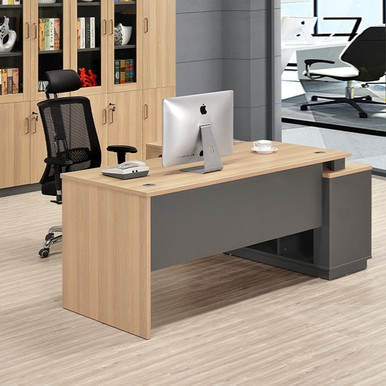
Aldric Modern Manager Desk with Side Cabinet -- from SGD 828 with free islandwide delivery to your doorstep at Linear Furnishings Singapore
Comparison with Every Alternative Desktop Material
Sintered Stone vs Marble
Marble is a metamorphic rock — natural calcite or dolomite that has undergone recrystallisation under geological heat and pressure. Its aesthetic appeal is unquestioned. Its practical limitations in a Singapore office environment are significant:
| Property | Sintered Stone | Marble | Practical Implication |
|---|---|---|---|
| Porosity | <0.05% | 0.2–2.0% (significant) | Marble absorbs liquids — coffee, wine, ink permanently stain |
| Acid resistance | Complete | Very poor — calcite dissolves in acid | Coffee (pH 5) permanently etches marble — non-reversible damage |
| Hardness | Mohs 6–7 | Mohs 3–5 | Sintered stone resists scratching from keys, metal objects; marble does not |
| Maintenance | None beyond wiping | Professional sealing every 6–12 months | Marble sealing costs SGD 100–300 per service |
| Singapore humidity | Unaffected — non-porous | Slight absorption in high humidity — promotes biological growth in pores | Sintered stone eliminates this risk entirely |
Sintered Stone vs Engineered Wood
| Property | Sintered Stone | E0 Engineered Wood |
|---|---|---|
| Formaldehyde | Zero | ≤0.05mg/m³ (low but present) |
| Water absorption | <0.05% | 8–15% (significant moisture absorption risk) |
| Surface hardness | Mohs 6–7 | Surface lacquer only — substrate easily damaged by impact |
| Heat resistance | >300°C | Surface lacquer damaged at >70°C |
| Long-term appearance | Permanent — no aging | Lacquer requires reconditioning/refinishing over time |
| Singapore suitability | Excellent | Good with PUR sealing |
Sintered Stone vs Tempered Glass
Glass desktops offer visual transparency and a sleek aesthetic. Against sintered stone:
- Fingerprints: Glass shows every fingerprint continuously; sintered stone's matte or textured surface is fingerprint-resistant
- Scratch resistance: Glass scratches easily from keys and metal; sintered stone resists scratching from most objects
- Impact resistance: Tempered glass shatters under sufficient impact; sintered stone chips at impact points without catastrophic failure
- Thermal: Glass transmits heat rapidly; sintered stone insulates better
Sintered Stone in Singapore's Executive Office: The Practical Case
- Hot mugs directly on the surface: Singapore executives routinely place hot coffee cups on their desks. Sintered stone handles this without risk — unlike lacquered wood (scorches), marble (can crack under thermal shock), or glass (transmits heat, can crack).
- Zero maintenance: Singapore's busy executive schedule leaves no time for furniture maintenance. Sintered stone requires nothing beyond a wipe with a damp cloth — no polishing, no sealing, no conditioning.
- Permanent appearance: The stone surface does not age — it looks identical in year ten as in year one. Lacquered wood desks require periodic refinishing to maintain appearance.
- Hygienic surface: The non-porous surface prevents bacterial and fungal growth — relevant in Singapore's warm, humid environment where porous surfaces can harbour microbial growth.
Sintered Stone Quality: What Specification Matters
| Specification | Standard Grade | Premium Grade | What It Means |
|---|---|---|---|
| Thickness | 6mm + frame | 12mm or 20mm (full slab) | Thicker slabs need less frame support; more substantial feel |
| Water absorption | <0.05% | <0.02% | Premium sintering process — even less porosity |
| Flexural strength | ≥40 MPa | ≥60 MPa | Better resistance to impact and point loading |
| Flatness | ±0.5mm/metre | ±0.2mm/metre | Premium flatness for flush panel alignment |
| Edge finish | Basic edge | Mitered or profiled edge | Edge finish quality visible at desk perimeter |
Major Sintered Stone Brands
Laminam (Italy): Pioneered large-format thin sintered stone (3mm, 5mm, 6mm). Premium architectural specification.
Stonker (Spain / Porcelanosa group): Ultra-compact surface, premium specification.
Monalisa (蒙娜丽莎, China): China's largest sintered stone manufacturer. Export quality production for premium furniture.
Jianyi (简一岩板): Premium Chinese manufacturer, increasingly specified in high-end Singapore furniture.
Frequently Asked Questions
What thickness of sintered stone is appropriate for a director table desktop?
Standard for director tables: 6mm sintered stone bonded to an engineered wood substrate (providing rigidity and additional mass). Premium configurations use 12mm or 20mm full-slab sintered stone — these are self-supporting and provide a more substantial, luxurious feel without the need for a substrate. For Singapore's executive office context, 12mm provides an excellent balance of weight (approximately 30kg/m²) and presence.
Does sintered stone chip or crack?
Sintered stone can chip at edges under sharp direct impact — it is not infinitely impact-resistant. However, it is significantly more impact-resistant than marble, glass, or surface lacquer. Normal office use — placing objects on the surface, typing, resting items — presents zero risk. Edge chipping can occur if the desk is struck sharply at the edge by a hard object; this is why quality sintered stone director tables have protective edge profiles at vulnerable corners.
Is sintered stone worth the premium over a quality lacquered wood director table?
For Singapore executives who want zero maintenance and maximum durability, yes. The premium over a comparable lacquered wood table is typically SGD 200–400. Over a 10-year lifespan, zero maintenance costs versus periodic reconditioning of lacquered surfaces, and the elimination of any surface damage risk, makes the premium economically rational. The decision ultimately depends on whether the executive values the warmth of wood aesthetics or the performance certainty of stone.