
In 2002, French designer Philippe Starck completed one of the most surprising acts in contemporary design: he took the elaborate, gilded armchair of King Louis XVI — the very symbol of aristocratic excess — and remade it entirely in transparent polycarbonate. The result, the Louis Ghost Chair, has sold over three million units across the world since its release. The Otto Transparent Stool at Linear Furnishings Singapore draws on the design language this innovation established.
Philippe Starck: Democratic Design for Everyone
Born in Paris in 1949, Philippe Starck studied at the École Nissim de Camondo in Paris before beginning a career that would make him simultaneously the world's most recognisable and most controversial designer. His philosophical position was clear and consistent: intelligent design should not be reserved for the wealthy but made accessible to everyone. 'Design should not be a luxury,' Starck has argued throughout his career. 'It should be democratic.'
This conviction drove his collaboration with Kartell — the Italian manufacturer that, under Claudio Luti's direction from 1988, was determined to make plastic a 'noble material' worthy of design investment. Kartell invested heavily in polycarbonate research: a material with the transparency of glass, the impact resistance of engineering thermoplastics, and the formability of injection-moulded plastic.
The Louis Ghost: Baroque History Made Invisible
Starck's description of his own design process for the Ghost Chair is characteristically philosophical: 'Louis Ghost becomes democratic design 2.0... The universal success of the Louis Ghost chair does not come from its design but from collective memory. The Louis Ghost chair was produced by our collective subconscious and it is only the natural result of our past, our present and our future.'
The design logic was elegant: take the most recognisable silhouette in Western furniture history — the Louis XVI medallion-back armchair — and render it in the most contemporary material available. The result is simultaneously historical and futuristic, immediately familiar yet utterly new. The baroque scrollwork of the back, the curved arms, the classical proportions — all present, but translated into a material that makes them almost disappear.
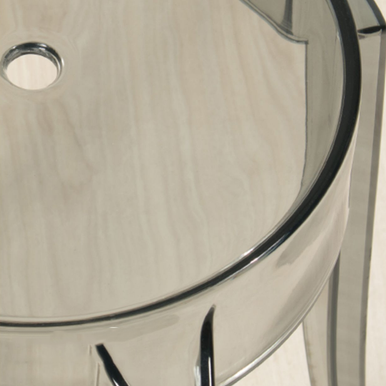
Otto Transparent Stool Chair Nordic Style — SGD 106 with free delivery to your doorstep at Linear Furnishings Singapore
The Design Principle: Transparency as Space-Making
The Ghost Chair's most significant design contribution was demonstrating that transparent furniture has a unique spatial property: it occupies a position in a room without visually claiming it. A solid chair in a small room is furniture. A transparent chair in a small room is almost nothing — the eye passes through it, the space reads as continuous, the room appears larger.
This principle — that transparency is a spatial tool, not merely an aesthetic choice — became one of the defining concepts of 21st-century interior design. It is particularly relevant to Singapore's compact HDB and condo interiors, where every centimetre of perceived space matters.
- Visual neutrality: Transparent furniture works with any colour scheme and any existing furniture — it has no colour to clash with
- Space amplification: The eye reads through transparent furniture to the floor and walls beyond — the room appears larger than it is
- Sightline preservation: In open-plan layouts, transparent furniture preserves visual connection between zones rather than creating barriers
- Temporal flexibility: A chair that does not assert a strong visual identity can remain appropriate as interiors evolve over time
Polycarbonate vs Acrylic: Understanding Transparent Furniture Materials
Not all transparent furniture is the same. The original Ghost Chair uses polycarbonate (Bayer Makrolon) — an engineering thermoplastic that is virtually unbreakable under normal conditions, used in bulletproof glazing and aircraft windows. Acrylic (PMMA) is lighter and typically more affordable but more susceptible to impact damage. For Singapore buyers, understanding the material specification of transparent furniture is worth the inquiry.
Frequently Asked Questions
Why does transparent furniture make rooms look larger?
Transparent furniture creates the optical illusion of more space because the eye does not register it as a visual barrier. When you look across a room, opaque furniture interrupts the sightline and visually 'claims' floor space. Transparent furniture allows the sightline to continue to the floor, walls, and other elements behind it — the brain registers the room as more spatially continuous. This is particularly effective in Singapore's compact interiors where achieving a sense of spaciousness is a primary design goal.
How do you clean transparent acrylic or polycarbonate furniture?
Use a soft microfibre cloth dampened with mild soapy water. Rinse with clean water and dry immediately to prevent water spots. Never use abrasive cleaners, scouring pads, or acetone-based products (including nail polish remover) which permanently damage the surface. For stubborn marks, a plastic-specific cleaner applied with a soft cloth is effective. Minor surface scratches in acrylic can be buffed out with plastic polish.
Is transparent furniture practical for Singapore homes with children?
Transparent furniture is popular in Singapore family homes specifically because spills and marks are immediately visible — and because the material (polycarbonate especially) is highly impact-resistant. Polycarbonate chairs are virtually unbreakable under normal use. Acrylic is more susceptible to cracking under sharp impact. For homes with young children, specify polycarbonate over acrylic where possible.