
The seat cushion is where ergonomics meets chemistry. The difference between a seat that maintains its support for five years and one that permanently deforms within six months is not the covering material — it is the foam density, formulation, and manufacturing quality beneath it. This guide examines seat cushion construction from the chemical reaction that creates foam to the practical quality tests Singapore buyers can perform in any showroom.
How Polyurethane Foam Is Made
All office chair foam — from budget to premium — starts with the same chemical reaction: polyol and diisocyanate (MDI or TDI) react in the presence of water, creating polyurethane and releasing CO₂ as the blowing agent. This CO₂ forms the bubbles that become the foam's cell structure. The density, resilience, and durability of the resulting foam are determined by:
- Polyol molecular weight: Higher molecular weight → more flexible, more resilient foam
- Isocyanate index: The ratio of isocyanate to polyol — determines crosslink density and firmness
- Curing temperature and time: Premium HR foam cures at 60–70°C for 24 hours; budget foam may be inadequately cured
- Cell structure uniformity: Controlled by silicone stabiliser type and concentration
TDI vs MDI: The Diisocyanate Question
TDI (toluene diisocyanate) is the traditional foam component — reactive, lower cost, and widely used in commodity foam. It produces more volatile emissions during and after manufacturing, including residual TDI in finished foam that off-gasses over time. The 'chemical smell' from new office chairs is predominantly TDI-related.
MDI (methylene diphenyl diisocyanate) is larger, less volatile, and produces lower-emission foam. Premium HR foam for quality office chairs increasingly uses MDI or MDI/TDI blends. If a new chair has a minimal chemical smell, MDI formulation is likely.
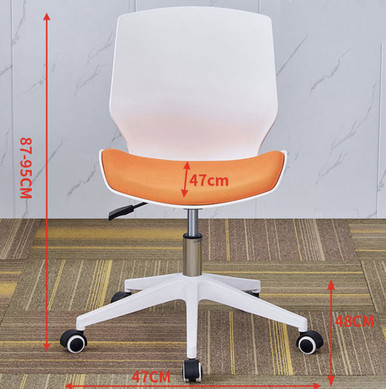
Fausto Swivel Office Chair -- from SGD 79 with free islandwide delivery at Linear Furnishings Singapore
Updated May 2025 -- All specifications verified. Browse our office chair range
Foam Density and Performance Standards
| Parameter | Test Standard | Budget | Acceptable | HR Standard | Premium HR |
|---|---|---|---|---|---|
| Density | ISO 845 | <28 kg/m³ | 28–32 kg/m³ | 36–45 kg/m³ | 45–56 kg/m³ |
| 25% IFD Hardness | ASTM D3574 | Any | 18–22 lbs | 20–26 lbs | 22–28 lbs |
| Resilience (ball rebound) | ISO 8307 | <35% | 35–42% | ≥50% | ≥55% |
| Compression set (75% deflection, 22h) | ISO 1856 | ≥25% | 15–20% | ≤10% | ≤8% |
| Tensile strength | ISO 1798 | <70 kPa | 70–90 kPa | ≥100 kPa | ≥120 kPa |
| Elongation at break | ISO 1798 | <80% | 80–110% | ≥120% | ≥150% |
The compression set number is the most practically relevant: it measures how much permanent deformation occurs after sustained loading. A compression set of 8% means that after being compressed to 75% of its original height for 22 hours, the foam recovers to 92% of its original height. Budget foam at 25% compression set means only 75% height recovery — visible as permanent indentation after months of use.
The 'Butt Dent' Test: Why It Indicates Foam Failure
A visible permanent indentation in a showroom display chair is not the result of heavy use — it is evidence of insufficient foam density. Standard HR foam (≥36 kg/m³, ≤10% compression set) will not show visible permanent indentation under normal single-user loading in a showroom environment. When indentation is visible on a new display model that has seen only showroom traffic, the foam density is almost certainly below 30 kg/m³.
Spring + Foam Composite: The Premium Benchmark
High-performance office chairs increasingly use independent coil spring systems beneath a foam comfort layer — the same construction used in premium mattresses. Individual fabric-encased springs (carbon steel wire diameter 2.0–2.5mm) respond independently to loading, providing point-specific support without cross-transfer. The foam layer (typically 30–50mm) provides comfort and surface feel; the springs handle structural load.
This composite construction essentially eliminates the permanent deformation problem: springs maintain their geometry indefinitely, and the comfort foam is never subject to sustained structural loading. Lifespan: 10–15 years for the spring system; 5–8 years before the comfort foam may benefit from replacement.
Key supplier: Leggett & Platt (USA) is the global leader in spring-foam composite seating systems, supplying most major premium chair brands.
Foam Failure in Singapore's Climate
| Failure Mode | Cause | Singapore Acceleration | Prevention |
|---|---|---|---|
| Permanent deformation | Insufficient density → cell wall collapse under load | No climate effect — density is the sole factor | Specify ≥36 kg/m³ HR foam |
| Foam hardening | Plasticiser evaporation + oxidation | Temperature 30°C: 2× plasticiser evaporation vs. 20°C | MDI foam, proper covering material |
| Foam brittleness | Hydrolysis: humidity + acids break polymer chains | 75–85% RH accelerates hydrolytic degradation | PU foam with hydrolysis-resistant polyol formulation |
| Chemical off-gassing | TDI residual in budget foam | Temperature accelerates off-gassing rate | MDI-based foam, proper curing, ventilation |
Major Foam Suppliers
Taiwan (Dadi Chemical / 大地化工): The HR foam benchmark for premium Asian office furniture. Supplies major ergonomic chair manufacturers. Consistent density and compression set specifications.
Foshan, Guangdong (海丰泡棉 and others): China's largest foam production cluster. Wide quality range from commodity to mid-premium. Price-quality relationship is largely reliable at this production cluster.
Leggett & Platt (USA): Global leader in spring-foam composite systems. Their IntelliCoil and similar technologies define the premium office seating standard.
Recticel (Germany/Belgium): Premium European foam with OEKO-TEX Standard 100 certification — verified free from harmful substances. Used in European high-end office chairs.
Frequently Asked Questions
What foam density should I look for in a Singapore office chair?
HR foam at ≥36 kg/m³ (2.2 lb/ft³) is the professional standard. At this density, the foam maintains its support properties under daily use without permanent deformation. Budget foam below 32 kg/m³ will develop visible permanent indentation within 3–6 months of regular use.
Why does my new office chair smell chemical?
The smell is predominantly TDI (toluene diisocyanate) residual from foam manufacturing. It is more pronounced in budget chairs that use TDI-based foam and shorter curing times. The smell dissipates as residual TDI off-gasses — typically 48–72 hours of ventilation. If the smell persists beyond a week, consider returning the chair, as excessive TDI residual indicates inadequate manufacturing quality control.
Is memory foam good for office chairs in Singapore?
Memory foam (viscoelastic foam) is temperature-sensitive — it softens when warm. In Singapore's conditions (even in air-conditioned offices at 24–26°C), memory foam remains in a relatively soft state throughout the working day, providing less postural support than HR foam. HR foam maintains consistent firmness regardless of temperature and is the more appropriate choice for Singapore's climate.