
Updated May 2025 -- All specifications verified. Browse our office chair range
Singapore's Workplace Safety and Health Act places responsibility on employers to provide safe working equipment. An office chair that structurally fails — whether through gas cylinder failure, base collapse, or backrest failure — is not merely a product defect. In a commercial context with multiple users and extended daily use, it represents a foreseeable safety risk that carries legal implications for the employer.
Understanding which safety certifications actually provide meaningful assurance — and which are marketing vocabulary — is the starting point for commercial office furniture procurement in Singapore.
BIFMA X5.1: The Primary Standard
The Business and Institutional Furniture Manufacturers Association (BIFMA) X5.1 standard — developed in the USA but widely adopted globally — provides the most comprehensive testing protocol for office seating. Critically, BIFMA certification is voluntary; a chair can be sold in Singapore without any BIFMA testing. This makes the presence or absence of certification a significant quality signal.
Complete BIFMA X5.1 Test Battery
| Test Category | Specific Test | Load | Cycles | Pass Criterion |
|---|---|---|---|---|
| Seat loading | Static load | 2,670 N (272 kg) | 1 min hold | No permanent deformation |
| Seat loading | Fatigue | 1,600 N (163 kg) | 250,000 cycles | No structural failure |
| Backrest | Static load | 890 N | 5 min hold | No permanent deformation |
| Backrest | Fatigue | 445 N | 100,000 cycles | No structural failure |
| Stability | Forward | 330 N at seat front | Single | No tipping |
| Stability | Rearward | 330 N at seat rear | Single | No tipping |
| Stability | Lateral | 220 N at seat side | Single | No tipping |
| Armrests | Downward static | 445 N | 10 sec | No failure |
| Armrests | Outward static | 222 N | 10 sec | No failure |
| Armrests | Fatigue | 222 N downward | 50,000 cycles | No structural failure |
| Gas cylinder | Height cycling | Rated load | 100,000 cycles | No height loss |
| Castors | Roll/swivel | Full chair weight + rider | 500,000 cycles | No failure |
BIFMA vs. Manufacturer Testing: A Critical Distinction
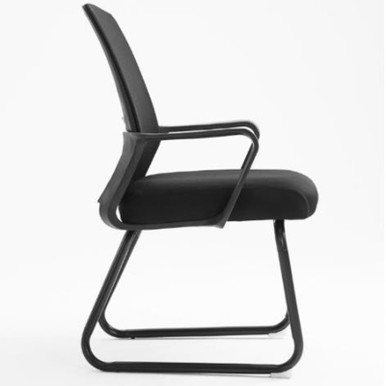
Milan Home Office Chair -- from SGD 129 with free islandwide delivery at Linear Furnishings Singapore
EN 1335: The European Standard
| Classification | User Weight | Daily Use Hours | Application |
|---|---|---|---|
| Category A (highest) | ≤110 kg | ≤8 hours | Commercial office, full-time use |
| Category B | ≤110 kg | ≤4 hours | Light commercial, part-time |
| Category C | ≤110 kg | Occasional | Home office, infrequent use |
EN 1335 is the mandatory safety standard for office chairs sold in the European Union. While not legally required in Singapore, EN 1335-A category certification provides equivalent assurance to BIFMA for commercial use. European furniture brands sold in Singapore should carry EN 1335 documentation.
TÜV Rheinland Certification: The Premium Standard
TÜV Rheinland certification goes beyond structural safety to include materials safety — testing for harmful substances including formaldehyde, heavy metals, phthalate plasticisers, and other VOCs in foam, upholstery, and structural components. For Singapore offices where indoor air quality is a priority, TÜV-certified chairs provide assurance that structural components and upholstery materials meet harm substance limits.
Chairs with TÜV certification will carry the TÜV Rheinland mark and a certificate number traceable on the TÜV website.
ISO 9241-5:2024: Ergonomic Requirements for Workstations
ISO 9241-5 (most recently updated in 2024) specifies posture and workstation layout requirements, including seat dimensions, adjustment ranges, and ergonomic performance criteria. Unlike BIFMA (structural safety) and EN 1335 (structural + ergonomic dimensions), ISO 9241 addresses whether the chair can actually be used in an ergonomically correct posture for the intended user population.
Load Rating by User and Use Scenario
| User Weight | Daily Hours | Recommended Specification | Base Material | Cylinder Class |
|---|---|---|---|---|
| Under 75 kg | Under 6 hours | BIFMA or EN 1335 | Nylon PA66 | Class 3 |
| 75–100 kg | 6–9 hours (standard office) | BIFMA X5.1 | Reinforced nylon | Class 4 |
| 100–120 kg | 6–9 hours | BIFMA X5.1 | Aluminium alloy | Class 4 heavy |
| Over 120 kg | Any | Heavy-duty specification | Aluminium alloy | Class 4 heavy-duty |
| Multiple users (hot-desking) | Variable | BIFMA X5.1 — highest priority | Aluminium alloy | Class 4 |
Five-Star Base: Geometry and Materials Science
The five-star base design satisfies BIFMA stability requirements through geometry rather than simply weight. Five arms at 72° spacing ensure that the stability polygon (the area within which the centre of gravity must remain for the chair not to tip) covers all directional loadings tested in BIFMA's stability protocol.
The distinction between virgin PA66 and recycled PA66 nylon is significant but visually nearly impossible to detect. Key differentiators: recycled nylon may show slight discolouration, small surface voids, or a faint chemical odour when new. Structural testing is the only reliable method of differentiation. For commercial procurement, requiring certification of virgin material use is appropriate.
Frequently Asked Questions
How do I verify that an office chair's BIFMA certification is genuine?
Ask the retailer for the certificate number and the name of the testing laboratory. Authentic BIFMA certification will name a specific accredited test lab (such as Intertek, SGS, Bureau Veritas, or a BIFMA-accredited facility). You can cross-reference the certificate number with the testing laboratory directly. A retailer who cannot provide a certificate number and laboratory name almost certainly has manufacturer testing, not independent certification.
Is BIFMA certification legally required for office chairs in Singapore?
No — BIFMA is a voluntary standard. Singapore's Workplace Safety and Health Act requires employers to provide safe working conditions but does not mandate specific furniture certifications. However, in the event of a chair-related workplace injury, the absence of independent safety certification would be relevant to employer liability assessment. For commercial procurement, BIFMA certification significantly reduces this risk.
Our company is furnishing 50+ workstations. What safety documentation should we require?
For commercial office procurement at this scale: require BIFMA X5.1 certification with certificate number and test laboratory name for all primary workstation chairs. Request EN 1335 Category A documentation as an alternative for European brands. For users above 100kg, request specific heavy-duty load capacity documentation beyond the standard BIFMA rating. Keep all documentation on file as part of your workplace safety records.