
Updated May 2025 -- All specifications verified. Browse our office chair range
Lower back pain affects an estimated 70–80% of Singapore's working population at some point in their careers. While multiple factors contribute, sustained seated posture without adequate lumbar support is a primary and well-documented cause. This guide examines the biomechanics of lumbar support, the engineering of recline mechanisms, and the quality specifications that separate functional ergonomics from marketing vocabulary.
Spinal Biomechanics: Why Lumbar Support Matters
The human lumbar spine (lower back) has a natural anterior curve — lordosis. When seated without support, the pelvis rotates backward, flattening or reversing this curve. The resulting kyphotic (C-shaped) seated posture creates several specific injury pathways:
- Disc loading: Annular fibres of lumbar discs (particularly L4-L5 and L5-S1) are placed under asymmetric tension in kyphotic posture
- Ligament loading: Posterior spinal ligaments are chronically stretched when lordosis is lost
- Paraspinal muscle fatigue: Sustained static muscle contraction to stabilise the flexed lumbar spine
The Nachemson Data: Quantifying the Problem
| Posture | L3 Disc Pressure (Relative) | Clinical Implication |
|---|---|---|
| Lying supine | 25 | Minimum spinal load — healing position |
| Standing upright | 100 | Reference standard |
| Sitting upright, no support | 140 | 40% more than standing — sustained injury pathway |
| Sitting upright, lumbar support | 110 | Lumbar support reduces load by 21% |
| Reclined 110°, lumbar support | 70 | Optimal working posture — 30% below standing |
| Forward lean (typing without support) | 180–220 | 80–120% above standing — common Singapore office posture |
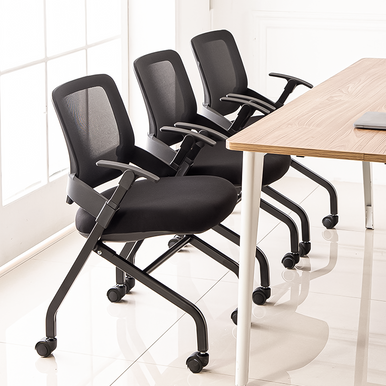
Zento Foldable Ergonomic Meeting Chair -- from SGD 79 with free islandwide delivery at Linear Furnishings Singapore
Lumbar Support Engineering: From Decorative to Functional
Fixed Lumbar: Adequate for Specific Body Dimensions Only
Fixed lumbar support — a moulded protrusion or locally thickened foam in the backrest — is correctly positioned for one specific seat height and user torso length. Outside this range, it either contacts the wrong spinal level (reducing effectiveness) or fails to contact the spine at all (providing no support). For office environments with a single regular user whose dimensions match the chair's design, fixed lumbar is acceptable. For shared chairs or users outside the design anthropometry, adjustability is essential.
Height-Adjustable Lumbar: The Minimum Functional Specification
Height adjustment (typically ±40mm via worm gear mechanism) allows the lumbar support to contact the L3–L5 region for users of different heights. The worm gear (蜗轮蜗杆) converts rotational input (knob turning) to linear vertical movement with inherent self-locking — the mechanism holds position without springs or brakes. Quality worm gear mechanisms operate smoothly with consistent resistance across the full adjustment range; budget versions may have stiff points or loose sections indicating dimensional inconsistency in the gear teeth.
Depth-Adjustable Lumbar: Matching the Curve
Lumbar curve depth varies significantly between individuals. The depth adjustment (cam mechanism, typically 0–40mm projection) allows the support intensity to be matched to the user's specific lordotic curve. Without depth adjustment, a deep lumbar projection that supports one user perfectly will feel like a painful prod for a user with minimal lordotic curve.
4D Lumbar: The Professional Standard
Four-dimensional lumbar adjustment (height + depth + width + sometimes lateral tilt) allows precise matching to individual spinal anatomy. The engineering involves multi-axis mechanical linkages or electric actuators. Premium implementations like Herman Miller's LiveBack system use the backrest flex itself as a lumbar adjustment mechanism — the backrest contours to the user's spine dynamically as they move, rather than maintaining a fixed support geometry.
Recline Mechanism Engineering
Why Synchro Tilt Outperforms All Alternatives
The synchro tilt mechanism couples the backrest and seat through a mechanical linkage with a 2:1 ratio. When the backrest reclines 20°, the seat pan tilts 10°. This ratio approximates the natural kinematics of the human hip and spine during reclination — the angle change of the torso-to-thigh relationship is roughly twice the angle change at the hip.
The practical consequence: in a synchro tilt chair, the user's feet remain flat on the floor throughout the recline range, the lumbar support maintains appropriate contact, and the sitting bones (ischial tuberosities) remain correctly positioned on the seat pan. In standard tilt chairs, reclining pivots from the rear of the seat — causing feet to lift, the pelvis to slide forward on the seat, and lumbar support to lose contact.
Synchro Tilt Component Quality
| Component | Quality Grade | Budget Grade | Quality Indicator |
|---|---|---|---|
| Main casting | Die-cast aluminium ADC12 | Glass-fibre reinforced plastic | Metal vs. plastic — weight and feel |
| Tilt spring | Coil spring, adjustable pre-tension | Fixed spring | Presence of tension adjustment knob |
| Linkage tolerances | <0.1mm gaps — silent | 0.3–0.5mm gaps — metallic sounds when reclining | No sound during recline movement |
| Lock positions | 4–7 positions | 2–3 positions | More lock positions = finer control |
| BIFMA test | 100,000 cycles at 445N backrest force | Manufacturer testing only | BIFMA certificate |
Mesh Backrest: Manufacturing and Quality Standards
| Specification | Budget Mesh | Standard Mesh | Quality Mesh |
|---|---|---|---|
| Yarn denier | <800D | 1000D | 1200–1500D |
| Weave density | <8 holes/cm² | 10 holes/cm² | 12 holes/cm² |
| Air permeability | <1000 mm/s | 2000 mm/s | ≥3000 mm/s |
| 3-year sag | >3cm centre sag | 1–2cm | <1cm |
| Edge retention | Frame loosens within 12 months | 2–3 years | 5+ years |
| Yarn composition | Single polyester | Polyester/nylon blend | Multi-component with elastic memory |
Major Suppliers
Donati (Italy): Europe's most significant chair mechanism manufacturer. Supplies premium chair brands globally. Their synchro tilt mechanisms define the quality benchmark.
TFT (Taiwan): Asia's leading quality mechanism manufacturer. Supplies Herman Miller's Asian manufacturing operations and other premium brands.
Shunde, Guangdong: China's largest chair mechanism production cluster. Quality ranges from commodity to mid-premium. Mechanism quality at this cluster generally correlates with price tier.
Frequently Asked Questions
How do I know if my office chair's lumbar support is actually doing anything?
Sit fully back against the lumbar support. Your lower back should feel gentle, continuous pressure at approximately belt level — the inward curve of the lower back (L3–L5 vertebrae). If you feel no contact at all, the lumbar is too small or too far back (add depth if adjustable). If it feels painful or pushes your upper body forward, it is too large or too high. Correct lumbar support should be noticeable but comfortable.
Is mesh or foam backrest better for Singapore's climate?
Mesh is significantly better for Singapore. A mesh backrest allows continuous airflow across the entire back surface — eliminating the heat and moisture accumulation that foam-backed chairs produce. For executives who prefer leather appearance, a leather seat with mesh back is a reasonable compromise. Full leather backs produce noticeably more back perspiration in Singapore's conditions even in air-conditioned spaces.
What recline angle is best for sustained computer work?
Research on spinal disc pressure consistently indicates that a recline of 100–110° (slightly past vertical) minimises lumbar disc loading while maintaining alert focus. The exact neutral angle at which back muscles relax — neither contracting to hold upright nor having to stabilise a lean — varies by individual. Most users find it between 100° and 108°. Set this as your locked working position and allow full float during phone calls and non-screen tasks.