
Updated May 2025 -- All specifications verified. Browse our office chair range
Most Singapore office chair buyers evaluate leather by how it looks and feels in the showroom. This guide goes deeper: from the tannery floor to the finished chair, understanding how different leathers are manufactured explains precisely why they perform so differently — and why Singapore's tropical climate makes the material choice more consequential than most buyers realise.
The Leather Production Hierarchy: Seven Grades Explained
Understanding leather grades requires understanding that a single animal hide contains multiple layers, each with distinct structural properties. The further from the outer surface, the weaker the fibre structure — and the lower the grade.
Full-Grain Leather: The Outer Surface, Unaltered
Full-grain leather uses the outermost layer of the hide — where collagen fibres are most tightly packed and strongest. The natural surface texture (grain) is preserved, including natural marks and variations. This is not a flaw; it is evidence of genuine full-grain construction.
Manufacturing process: After tanning (chrome tannage: 2–4 days; vegetable tannage: 30–60 days), the leather is dried, softened, and given a light protective coating — enough to seal the surface without obscuring the natural grain. Total processing: 4–6 weeks.
Top-Grain Leather: Sanded and Finished
Top-grain uses the same outer hide layer as full-grain, but the surface is lightly sanded (buffed) to remove natural imperfections, then finished with a polymer coating. The result is more uniform in appearance but slightly less breathable and less structurally resilient than full-grain.
Napa Leather: Softness as a Design Goal
Napa refers to a specific tanning and finishing process — not a layer of the hide. Full-grain or top-grain leather is processed with a modified tannage (typically combining chrome tannage with additional softening agents) to achieve the butter-soft texture associated with luxury automobiles and premium furniture. Napa leather is the executive chair standard for genuine luxury seating.
Genuine Leather: The Most Misleading Term in Furniture
'Genuine leather' is technically accurate — the material is real leather. But it refers to the lowest grade of real leather: the inner split layers of the hide, where fibre structure is loosest and weakest. The naming convention is deliberately confusing. Most consumers assume 'genuine' implies quality; in the leather industry, it indicates the opposite end of the real-leather spectrum.
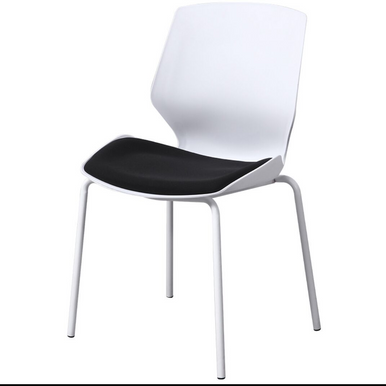
Luno Conference Chair -- from SGD 68 with free islandwide delivery at Linear Furnishings Singapore
PU Leather: Manufacturing, Grades, and Why It Fails
How PU Leather Is Made
PU leather consists of a polyurethane coating applied over a fabric base. Two manufacturing processes produce fundamentally different products:
Wet process (湿法): A polyurethane solution containing DMF solvent is coated onto the base fabric and passed through a water bath. The water displaces the DMF, causing the PU to coagulate into a microporous structure. The result has limited breathability (2–8 ml/cm²/h — roughly 1/15th of full-grain leather) and better durability. This process is used for higher-grade PU.
Dry process (干法): A PU film is formed on release paper, then bonded to the fabric base under heat and pressure. Completely non-breathable. Faster and cheaper. Used in most budget office chairs.
Why PU Leather Peels: The Chemistry
PU leather peeling is not a manufacturing defect — it is an inherent consequence of the material's layered construction. Four degradation mechanisms operate simultaneously in Singapore's environment:
| Mechanism | Process | Singapore Acceleration |
|---|---|---|
| Plasticiser migration | Softening agents evaporate or migrate out → PU becomes brittle | Temperature 30°C vs. 20°C baseline: approx. 2× faster evaporation |
| Thermal oxidation | O₂ + heat → polyurethane chain scission → loss of elasticity | Continuous tropical heat accelerates oxidation |
| Hydrolysis | Humidity + perspiration acids → ester bond cleavage → material disintegration | 75–85% RH + skin contact pH 5.5: accelerated ester hydrolysis |
| Delamination | Thermal cycling (aircon vs. outdoor heat) + mechanical stress → coating separates from base | Daily 10°C temperature differential in Singapore offices creates repeated expansion/contraction cycles |
Bonded Leather: The Material Singapore Buyers Most Frequently Regret
Bonded leather is manufactured from the waste products of genuine leather processing — shredded fibres and scraps (10–20% real leather content) mixed with polyurethane adhesive and pressed onto a paper or non-woven backing. A polyurethane surface coating is applied and embossed to resemble genuine leather grain.
The problem is fundamental to the construction: the paper backing absorbs moisture (Singapore's 75–85% humidity provides this continuously), causing dimensional changes that break the adhesive bond between the backing and the PU surface coating. In Singapore's climate, this process typically produces visible peeling within 8–18 months of purchase.
Quantified Performance Comparison
| Property | Full-Grain | Top-Grain / Napa | Genuine | PU (Quality) | PU (Budget) | Bonded |
|---|---|---|---|---|---|---|
| Tensile strength (N/mm²) | 20–28 | 15–22 | 8–12 | 5–8 | 3–5 | 1–3 |
| Breathability (ml/cm²/h) | 100–180 | 70–140 | 40–70 | 2–8 | 0 | 0–2 |
| Flex fatigue (cycles) | 100,000+ | 80,000+ | 30,000–50,000 | 20,000–50,000 | <20,000 | <10,000 |
| Heat resistance (°C) | 120 | 100–110 | 80 | 60 | 50 | 50 |
| Singapore lifespan | 12–20 yrs | 8–12 yrs | 2–4 yrs | 2–3 yrs | 1–1.5 yrs | 8–18 months |
Global Supply Chain: Where Office Chair Leather Comes From
Genuine Leather Sources
Italy (Tuscany region): ILCEA, Conceria Walpier — the global benchmark for Napa leather. These tanneries supply the luxury automotive and furniture industries. When a Singapore furniture retailer claims Italian leather, ask for the tannery name.
Brazil: The world's largest cattle hide producer by volume. Price-competitive, quality ranges from commodity to premium depending on the processing facility.
China (Haining, Zhejiang): The world's largest leather trading market. Quality ranges from commodity to mid-premium. Accounts for most mid-range 'genuine leather' in Singapore's accessible market.
PU Leather Sources
China (Haining/Jiaxing, Zhejiang): Over 50% of global PU synthetic leather production. Major exporters: Hexin (禾欣), Yuandong Leather (远东皮业). Export price: USD 2–12/m² from budget to quality. Almost all budget PU leather office chairs in Singapore source from this region.
South Korea (Kolon, Skintex): Mid to premium synthetic leather, more consistent quality control than Chinese commodity production.
Japan (Kuraray Clarino): The global benchmark for microfibre PU — the material used in luxury automotive interiors and premium office chairs. Significantly more expensive but genuinely different in performance.
How to Identify Leather Type in Singapore Showrooms
| Test | Method | Full-Grain/Top-Grain | PU | Bonded |
|---|---|---|---|---|
| Burn test | Brief flame contact | Hair/organic smell | Plastic smell, self-extinguishing | Acrid + paper burning smell |
| Fold test | 90° sharp fold | Natural crease, slow recovery | No cracking (good), white crease (cheap) | Immediate cracking |
| Cross-section | Cut edge examination | Fibrous natural layers | Uniform coating over base fabric | Fragmented particles in binder |
| Water absorption | Drop of water on surface | Slowly absorbed | Beads on surface | Beads on surface |
| Price check | Ask price | SGD 600+ chairs | SGD 150–600 | 'Leather' below SGD 300 |
Frequently Asked Questions
How do I tell if a Singapore office chair is bonded leather or genuine leather?
Ask: 'Is this bonded leather, PU leather, top-grain, or full-grain?' A clear answer indicates an informed retailer. If the answer is 'genuine leather' without further specification, ask again: 'Is it split leather (inner layer) or top-grain (outer layer)?' Bonded leather typically retails in chairs below SGD 300 and has a perfectly uniform, embossed texture with no natural variation.
Does PU leather last in Singapore's humidity?
Standard dry-process PU leather lasts approximately 2 years in Singapore's conditions — roughly half its lifespan in temperate climates, due to accelerated plasticiser migration, oxidation, and hydrolysis. Quality wet-process PU (identifiable by limited breathability and firmer hand-feel) may achieve 3 years. For longer-lasting seating, mesh or genuine Napa leather are significantly better investments.
What is the difference between Napa leather and top-grain leather?
Both use the same layer of hide (outer surface). The difference is in processing: top-grain is sanded and coated for a uniform appearance. Napa leather uses a modified tanning process (more softening agents, additional processing steps) to achieve the butter-soft texture associated with luxury items. Napa typically costs 30–60% more than standard top-grain and offers comparable durability with superior tactile quality.