
Updated May 2025 -- All material specifications verified. Browse our director table range
Understanding how a director table is manufactured provides the context for evaluating quality claims that are otherwise impossible to verify at point of sale. This guide traces the complete production process — from incoming material inspection through to final quality control — explaining what separates factories producing furniture that lasts a decade from those producing furniture that deteriorates in years.
Stage 1: Incoming Material Inspection
Quality director table production begins before any cutting or forming. Incoming material inspection at serious furniture manufacturers includes:
| Material | Test Performed | Pass/Fail Criterion | Test Method |
|---|---|---|---|
| Engineered board | Formaldehyde emission | ≤E0 (≤0.05mg/m³) | Climate chamber method — 3-5 day test |
| Engineered board | Thickness uniformity | ±0.2mm across board face | Gauge measurement at 9 points |
| Engineered board | Moisture content | 8–12% | Moisture meter |
| Board surface laminate | Adhesion test | No delamination under 90° peel at 100N | Peel test |
| Edge banding | Colour match | Within ΔE<2 of board sample | Spectrophotometer |
| Hardware | Dimensional verification | Within tolerance specification | Gauge and caliper |
| PUR adhesive | Viscosity and reactivity | Manufacturer specification | Viscometer test |
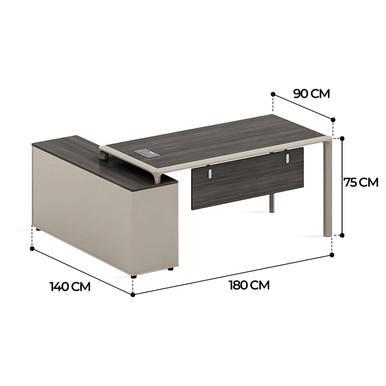
Olen Modern Boss Desk with Storage Cabinet -- from SGD 788 with free islandwide delivery to your doorstep at Linear Furnishings Singapore
Stage 2: Precision Cutting (开料)
Modern director table production uses computer-controlled beam saws (横切锯) programmed with cutting optimisation software that maximises yield from each board sheet while maintaining precise component dimensions.
| Cutting Parameter | Standard Quality | Premium Quality |
|---|---|---|
| Length/width tolerance | ±0.5mm | ±0.2mm |
| Diagonal difference | <2mm per metre | <1mm per metre |
| Saw blade | Standard carbide-tipped | Premium tungsten carbide — longer precision life |
| Kerf width | 3.2mm (standard) | 2.8mm (premium — reduces material loss) |
| Scoring blade | Present — prevents bottom surface chip-out | Present with fine adjustment |
| Cut optimisation software | Basic nesting | Advanced optimisation — reduces waste 5–15% |
Stage 3: Edge Sealing (封边) — The Quality-Determining Stage
Edge sealing is performed immediately after cutting, before any other processing — the exposed edges must be sealed before they absorb atmospheric moisture and expand. The edge sealing machine sequence:
- Panel feed: The cut panel enters the machine on a conveyor bed at 20–25 m/min
- Adhesive application: PUR or EVA adhesive applied at controlled temperature (PUR: 130–150°C in sealed applicator)
- Edge strip application: Edge strip (ABS, 0.4–2.0mm) pressed against adhesive-coated edge
- Pressure roller: Consolidates the bond
- Rough trimming: Removes edge strip excess above and below panel faces
- Fine trimming: Precise flush cut of edge strip to panel face
- Profiling/radius cutting: Applies specified corner radius
- Scraping: Removes any adhesive residue
- Final polishing: Micro-abrasive polishing for surface uniformity
Stage 4: CNC Drilling (数控钻孔)
Three-in-one connecting fittings require precise holes in both the panel face (for the cam nut) and the panel edge (for the cam bolt). The positional tolerance for these holes is ±0.2mm — if holes are off-spec, panels will not join flush, and the connecting fitting will be under stress that progressively damages the board.
Premium factories use 6-face CNC drilling machines that can process a panel on all faces in a single handling operation — eliminating the dimensional errors that accumulate when panels are re-positioned between multiple machines.
Stage 5: CNC Machining for Complex Forms
Director tables with curved desktops, shaped modesty panels, or profiled edges require CNC routing. Three-axis CNC machines handle flat-surface profiling; 5-axis machines are required for complex 3D forms. The CNC program is generated from the design CAD model — quality factories maintain an unbroken digital thread from design to production, eliminating human re-interpretation errors.
Stage 6: Surface Finishing (涂装) — The Visible Quality Statement
Environmental Requirements
High-quality lacquer application requires a controlled environment: temperature 20–28°C, relative humidity 40–70%, and an enclosed, air-filtered spray booth to prevent dust and particle inclusion in the wet lacquer film. The presence or absence of a climate-controlled spray booth is one of the most reliable indicators of finishing quality.
| Finishing Environment | Open Shop Floor | Enclosed Booth | Climate-Controlled Booth |
|---|---|---|---|
| Dust in finish | High — inclusions visible | Low | Minimal |
| Temperature control | None — seasonal variation | Partial | Full control |
| Humidity control | None | Partial | Full control |
| Film consistency | Variable | Consistent | Highly consistent |
| Typical application | Budget furniture | Mid-range | Premium furniture |
Standard UV+PU Production Process (Most Common Premium Process)
- Board surface sanding: 120-grit orbital sander, then 180-grit — prepares surface for coating adhesion
- Dust extraction: Compressed air blow-off + vacuum — any contamination produces visible finish defects
- UV primer roller application: Precise, machine-controlled film thickness (10–20μm)
- UV cure: 0.5–1 second under UV lamp
- Sanding: 180-grit — levels UV primer for next coat
- UV basecoat roller application: 20–40μm
- UV cure
- Sanding: 240-grit
- Transfer to spray booth: PU topcoat spray application — colour and gloss level
- Flash off: 10–15 minutes ambient
- Oven cure (if baked enamel specification): 80–130°C, 20–45 minutes
- Final inspection
Stage 7: Hardware Installation and Assembly
Director tables are shipped as flat-pack components and assembled on-site by installation professionals. Pre-production assembly at the factory — the 'trial assembly' stage — is the quality gate that identifies any dimensional or fitting issues before the furniture reaches the customer.
During trial assembly, every component is assembled in its shipping configuration, all fitting points are tested, and any non-conformances are identified and corrected. Factories that skip this stage rely on the customer's installation team to discover problems — creating callbacks and delays.
Stage 8: Quality Inspection (质量检验)
| Inspection Category | What Is Checked | Pass Criterion |
|---|---|---|
| Formaldehyde (finished product) | Climate chamber emission test | ≤E0 (0.05mg/m³) for product spec |
| Surface finish | Visual inspection under controlled lighting | Zero inclusions, uniform gloss, no orange peel |
| Dimensional accuracy | Key dimensions measured against drawing | ±1mm for non-critical, ±0.5mm for critical joints |
| Edge sealing | Visual inspection + flex test | Zero visible gaps, no lifting |
| Hardware function | Each drawer opened/closed 10× at assembly | Smooth, silent, aligned |
| Structural integrity | Load test on desktop | 100kg distributed load, no deflection >3mm |
Frequently Asked Questions
How can I tell if a director table has been manufactured to consistent quality standards?
The most reliable indicators: examine the edge sealing under direct light — even, narrow glue lines with no gaps indicate quality edge sealing equipment and material. Open and close drawers repeatedly — quality slides are consistent from first to last cycle in the showroom. Push gently on panel joints — zero movement indicates precise hole drilling and quality connecting fittings. These three tests together give a reliable quality indicator without needing to visit the factory.
Does it matter if a director table is assembled by the manufacturer's installation team vs. a general handyman?
Yes, significantly. Director table assembly requires knowledge of the specific fitting system, correct tightening sequence for connecting fittings, and drawer slide alignment. Incorrect assembly — wrong tightening sequence, misaligned slides, or undertightened connectors — can create permanent stress in the furniture structure that causes premature failure even in well-manufactured pieces. Linear Furnishings provides free delivery because we consider correct installation part of the product quality.
What quality certifications should a director table manufacturer have?
For the manufacturing process: ISO 9001 (quality management system) indicates systematic quality control. For the finished product: E0 or ENF formaldehyde certification from an accredited laboratory (not self-declared). For materials: CARB Phase 2 or FSC certification for wood source sustainability. For the finished furniture: BIFMA X5.5 (structural performance) or QB/T 2530 test reports. Not all manufacturers will have all certifications — ask specifically which are held and request documentation.