
Updated May 2025 -- All material specifications verified. Browse our director table range
Singapore has one of the most progressive indoor air quality regulatory frameworks in Asia — and it is tightening. The NEA's January 2026 ban on formaldehyde in interior paints, combined with the Ministry of Sustainability and Environment's confirmed review of composite wood regulations, places Singapore ahead of most Asian markets in addressing furniture-related formaldehyde risks. This guide explains Singapore's specific standards, what they mean for director table buyers, and why compliance matters in our enclosed, air-conditioned office environment.
Singapore's Primary Standard: SS 554:2016 + A1:2021
SS 554:2016 — Code of Practice for Indoor Air Quality for Air-Conditioned Buildings — is the foundational Singapore standard for office and commercial building air quality. Updated in 2021 (Amendment 1), it is referenced by the Ministry of Manpower and the Workplace Safety and Health Council as the benchmark employers must meet under the Workplace Safety and Health Act.
| Pollutant | SS 554:2016 Limit | Health Basis | Furniture Relevance |
|---|---|---|---|
| Formaldehyde | ≤0.1 mg/m³ (0.08 ppm) | WHO guideline, 8-hour average | Primary concern for all wood-based furniture |
| TVOC (Total VOC) | ≤0.3 mg/m³ | Cumulative health impact | Lacquer, adhesives, surface finishes |
| Benzene | ≤0.017 mg/m³ | IARC Group 1 carcinogen | Solvent in finishes and adhesives |
| Toluene | ≤0.3 mg/m³ | Neurological effects | Common lacquer solvent |
| PM2.5 | ≤25 μg/m³ | Respiratory health | Not furniture-specific |
| CO₂ | 700 ppm above outdoor | Ventilation indicator | Indirect indicator of adequate air change |
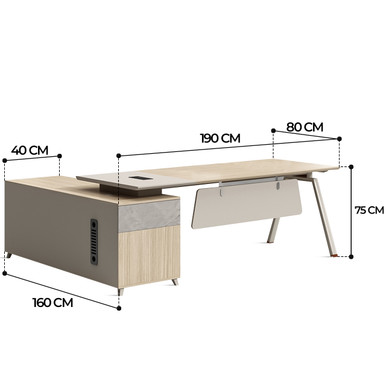
Olender Modern L-Shape Manager Desk -- from SGD 788 with free islandwide delivery to your doorstep at Linear Furnishings Singapore
Why Singapore's Air-Conditioned Offices Amplify Formaldehyde Risk
SS 554:2016 applies specifically to air-conditioned buildings — precisely the environment where Singapore executives work. The standard recognises what building science confirms: enclosed, air-conditioned spaces with limited natural ventilation accumulate indoor air pollutants more than naturally ventilated buildings.
Singapore's specific risk factors:
- Sealed office environments: Singapore's commercial offices operate with windows closed and recirculating air-conditioning. Formaldehyde accumulates rather than dispersing as it would in naturally ventilated spaces.
- Elevated ambient temperature: Singapore offices at 26–32°C ambient (even when air-conditioned internally to 22–24°C) accelerate formaldehyde off-gassing from furniture compared to European and North American baselines.
- High humidity: Singapore's 75–85% RH promotes moisture absorption and off-gassing from engineered wood products.
- Extended occupancy: Senior executives often occupy director offices for 10–12 hours daily — significantly higher than standard 8-hour workplace exposure assumptions.
The NEA Formaldehyde Regulatory Timeline in Singapore
| Date | Action | Authority | Significance |
|---|---|---|---|
| March 2024 | Minister Grace Fu statement: 'Prolonged exposure to formaldehyde can lead to negative health effects, including respiratory discomfort and increased risk of certain cancers' | Ministry of Sustainability & Environment | Government signals formaldehyde as health priority |
| April 2022 | SFIC signs Low Formaldehyde Commitment Pledge through Alliance for Action (AfA) | SFIC/AfA | Singapore furniture industry commits to low/no formaldehyde products |
| August 2024 | Parliamentary statement: NEA reviewing international best practices for potential regulation of composite wood products and adhesives | NEA/MSE | Furniture wood products explicitly under regulatory review |
| January 2026 | NEA ban: formaldehyde in interior paints must be <0.01% by weight | NEA/EPMA | First legal formaldehyde prohibition — signals direction for furniture |
| April 2025 | MSE written parliamentary reply: NEA 'actively reviewing potential regulatory requirements for formaldehyde in other interior building products' | MSE | Wood products and furniture next in regulatory pipeline |
| 2026 | SFIC Enhanced Sustainability Furniture Mark launches — first ASEAN certification covering full VOC range (not just formaldehyde) | SFIC | Singapore becomes ASEAN leader in furniture VOC standards |
International Certifications Singapore Recognises
Singapore does not currently have its own mandatory board emission classification for furniture (unlike the US CARB or EU EN standards). Instead, Singapore's commercial market accepts these internationally recognised certifications — all verifiable through accredited Singapore testing laboratories:
| Certification | Origin | Formaldehyde Limit | Singapore Market Status |
|---|---|---|---|
| CARB Phase 2 | US California Air Resources Board | Particleboard: ≤0.09ppm / MDF: ≤0.11ppm | ✅ Widely recognised — Green Mark buildings often require |
| GREENGUARD Gold | UL (USA) | Comprehensive VOC limits including formaldehyde | ✅ Recognised for Green Mark and commercial procurement |
| E0 (GB/T 39600) | China (international equivalent of EU E-LE) | ≤0.05mg/m³ | ✅ Accepted — widely available on Chinese-manufactured furniture |
| ENF (GB/T 39600) | China (world's strictest) | ≤0.025mg/m³ | ✅ Accepted — premium specification |
| F★★★★ (F4-Star) | Japan JIS standard | ≤0.02mg/L | ✅ Accepted — Japanese-manufactured furniture |
| FSC Certification | International | Wood source sustainability (not emissions) | ✅ Sustainability credential, not emissions standard |
The SFIC Sustainability Furniture Mark (SFM)
The Singapore Furniture Industries Council (SFIC) operates the Sustainability Furniture Mark — Singapore's own industry certification for low-formaldehyde furniture. Current SFM focuses on certified low-formaldehyde products; the Enhanced SFM launching in 2026 will extend to comprehensive VOC management including benzene and toluene — making it the first ASEAN-wide furniture VOC certification standard.
SFIC president Joshua Koh: "The Enhanced Sustainability Furniture Mark fills a critical gap by setting clear, science-backed requirements for VOCs management. It ensures that furniture in Singapore meets stringent safety standards, protecting the health of our people."
Practical Guidance: Director Table Selection Under Singapore Standards
| Scenario | Standard Applied | Recommended Specification | Documentation to Request |
|---|---|---|---|
| Standard commercial office | SS 554:2016 — 0.1mg/m³ formaldehyde | E0 minimum (≤0.05mg/m³) to maintain SS 554 compliance margin | E0 or CARB Phase 2 test certificate |
| Green Mark certified building | BCA Green Mark criteria | CARB Phase 2 or GREENGUARD Gold | CARB P2 or GREENGUARD certificate |
| Executive director suite | Best practice for health-conscious procurement | E0 or ENF | E0/ENF certificate; FSC for sustainability |
| Government/Statutory board office | WSH Act + SS 554:2016 | CARB Phase 2 or E0 minimum | Third-party test report from Singapore-recognised lab |
| Home office (Singapore residential) | SS 554 applies to commercial; residential: voluntary | E0 recommended for enclosed air-conditioned spaces | E0 certificate — voluntary but advisable |
Frequently Asked Questions
Does SS 554:2016 directly regulate furniture formaldehyde emissions?
SS 554:2016 regulates indoor air quality in air-conditioned buildings — it sets the formaldehyde limit for the room air (≤0.1mg/m³), not for the furniture itself. This means the employer is responsible for ensuring the combined formaldehyde contribution from all sources (furniture, flooring, finishes) does not cause room air to exceed this limit. Specifying E0-grade furniture is the practical way to manage this compliance obligation.
What happens if my Singapore office exceeds the SS 554:2016 formaldehyde limit?
The Workplace Safety and Health Act places responsibility on employers to maintain safe working conditions, including air quality. If an NEA or MOM inspection finds formaldehyde levels exceeding SS 554:2016 limits (0.1mg/m³), the employer faces compliance action, potentially including improvement notices, fines, or required remediation. The practical risk is greatest in newly fitted-out offices with multiple new furniture pieces.
Is it worth paying more for CARB Phase 2 or GREENGUARD certified director tables in Singapore?
For Green Mark certified buildings, CARB Phase 2 or GREENGUARD may be required for procurement compliance. For standard commercial offices, E0 certification is typically sufficient to demonstrate SS 554 compliance intention. The incremental cost of E0-certified furniture over standard production is small at the manufacturer level — if a retailer charges significantly more for E0 certification, question whether the base specification was compliant to begin with.