
Updated May 2025 -- All material specifications verified. Browse our director table range
Every engineered wood director table has cut edges — exposed cross-sections where the board's internal structure is directly accessible to moisture and air. These edges are where furniture fails. The quality of the edge sealing applied to these surfaces determines whether your director table maintains its structural integrity and appearance for 3 years or 12 years in Singapore's conditions.
Most Singapore furniture buyers never ask about edge sealing. This guide explains why it should be the first technical question you ask.
The Physics of Edge Failure in Singapore
Engineered wood boards are manufactured at controlled moisture content (6–10%). Singapore's ambient relative humidity (75–85%) means the boards are continuously absorbing moisture from the environment. The rate of moisture absorption is dramatically higher at cut edges than through sealed surfaces — industry data suggests 20–50 times higher absorption rate at unsealed edges versus sealed faces.
The consequence in Singapore's climate:
- Moisture enters the board core from cut edges
- Core expands — particleboard swells 8–15% in thickness under sustained moisture
- Surface laminate cracks as the core expands beneath it
- Edge seal debonds as differential expansion stresses the adhesive interface
- Further moisture ingress accelerates the process
- Formaldehyde off-gassing accelerates through compromised edges (edges emit 5–10× more formaldehyde per unit area than sealed surfaces)
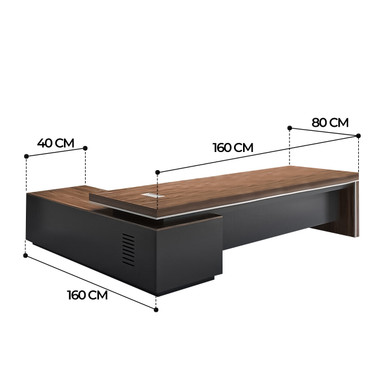
Olena Modern Executive Boss Desk -- from SGD 688 with free islandwide delivery to your doorstep at Linear Furnishings Singapore
EVA Edge Sealing: The Industry Default and Its Limitations
Chemistry and Process
EVA (ethylene-vinyl acetate) hot-melt adhesive is the most widely used edge sealing adhesive globally — accounting for an estimated 80% of commercial furniture production. It is a thermoplastic material: it melts when heated (applied at 150–180°C) and solidifies as it cools. The bonding mechanism is purely physical: the molten adhesive flows into surface irregularities and locks in place as it hardens.
Why Physical Bonding Fails in Singapore
| EVA Performance Factor | Temperate Climate | Singapore Climate |
|---|---|---|
| Bond durability | 5–8 years before visible degradation | 2–4 years before degradation begins |
| Glue line appearance | Yellows gradually | Yellows faster, accumulates dirt in micro-fractures |
| Thermal cycling impact | Minimal | Significant — daily 8°C+ temperature differential |
| Moisture resistance | Adequate | Insufficient for 75–85% RH |
| Typical failure mode | Gradual yellowing | Debonding and swelling within 3–5 years |
PUR Edge Sealing: The Correct Specification for Singapore
The Chemistry That Makes PUR Different
PUR (Polyurethane Reactive) hot-melt adhesive is chemically fundamentally different from EVA. When PUR is applied (at 130–150°C in a sealed, moisture-free applicator) and the edge strip is pressed into contact, the adhesive reacts with atmospheric moisture to form urethane linkages — permanent chemical cross-links between polymer chains.
The critical consequence: once cured, PUR adhesive cannot be re-melted by heat. The chemical cross-links are stronger than the physical lock of EVA and immune to the thermal cycling that breaks EVA bonds over time.
| PUR vs EVA | PUR | EVA |
|---|---|---|
| Bond mechanism | Chemical cross-linking (irreversible) | Physical lock (reversible with heat) |
| Glue line width | <0.3mm — nearly invisible | 0.5–1.0mm — visible as 'white line' |
| Bond strength (peel) | ≥140N/25mm | 30–50N/25mm |
| Thermal resistance | No softening — chemically stable | Softens at 70–80°C |
| Moisture resistance | Excellent — urethane bonds resist hydrolysis | Poor — moisture enters and weakens bond |
| Singapore lifespan | 10+ years | 2–4 years before visible degradation |
| Material cost | 3–4× EVA | Base reference |
| Formaldehyde contribution | Zero | Some (solvent and resin content) |
How to Test Edge Sealing Type
The standard industry test is the heat gun test: apply moderate heat (50–60°C) to the edge strip of a demonstration piece. EVA-sealed edges will detach readily when heated — the thermoplastic bond re-melts. PUR-sealed edges will not detach under moderate heat because the chemical cross-links cannot be broken by thermal energy alone.
In showroom conditions without a heat gun: PUR-sealed edges show a glue line of less than 0.3mm. EVA-sealed edges show a clearly visible glue line of 0.5–1mm. The difference is visible under normal lighting on lighter-coloured edge strips.
Major PUR Adhesive Suppliers
| Supplier | Country | Grade | Singapore Market Presence |
|---|---|---|---|
| Henkel (汉高) | Germany | Industrial premium — Technomelt PUR series | Used by top-tier Chinese furniture manufacturers |
| Jowat | Germany | High-end, specialist formulations | Premium custom furniture standard |
| Sika | Switzerland | Industrial grade | Construction and furniture applications |
| Hantuo (韩拓) | China | Good quality domestic PUR | Middle-market Chinese furniture standard |
| Yongtai (永特耐) | China | Acceptable quality | Budget-end Chinese furniture |
Edge Sealing Equipment: Why the Machine Matters
Edge sealing quality is not solely determined by the adhesive — the machinery applying it matters equally. Premium edge banding machines (HOMAG, IMA from Germany; SCM from Italy) apply adhesive at precisely controlled temperatures, pressures, and feed rates — ensuring consistent glue line thickness and bond quality. Budget machines operating with wider tolerances produce variable results even with quality PUR adhesive.
The post-sealing operations — trimming, scraping, profiling, and polishing — are equally important. A perfectly bonded edge with poor trimming will show ragged edges and glue residue. World-class furniture manufacturers use computerised machines for all post-sealing operations, eliminating the variation inherent in manual finishing.
Laser Edge Sealing: The Premium Frontier
Laser edge sealing represents the current frontier of edge sealing technology. Instead of adhesive, a laser beam activates a functional polymer layer on the back of a specialised edge strip, fusing it directly to the board surface at a molecular level — producing a zero-glue-line edge with no potential adhesive failure point.
The technology exists and works. The limitation is economic: laser edge sealing machines cost RMB 2–5 million each, require specialised edge strips (5–10× standard ABS cost), and fewer than 200 Chinese furniture factories have adopted the technology. For Singapore buyers, encountering laser-sealed director tables in accessible price ranges remains uncommon — but premium custom furniture from leading Chinese manufacturers increasingly uses this specification.
Frequently Asked Questions
Can I upgrade the edge sealing on an existing director table?
Edge sealing is applied during manufacturing and cannot be meaningfully upgraded post-purchase. If you suspect an existing director table has EVA edge sealing that is beginning to fail, applying PU-based edge sealant to visible gaps can temporarily arrest moisture ingress — but this is a repair, not an equivalent to factory-applied PUR sealing. The correct solution for a long-term Singapore office is to specify PUR sealing at purchase.
How do I identify poor edge sealing before purchasing?
Check the edge strips on display chairs and tables: a visible glue line wider than 0.5mm indicates EVA sealing. Yellowed or darkened glue lines on older display models indicate EVA failure progression. Also check whether edge strips align perfectly with the surface laminate colour — mismatched edge strips (common in budget furniture) indicate cost-cutting that likely extends to adhesive quality.
Does edge sealing quality affect formaldehyde emissions?
Significantly yes. The cut edges of engineered wood boards emit formaldehyde at 5–10 times the rate per unit area of sealed surfaces. Quality PUR edge sealing effectively seals the board core, reducing total formaldehyde emissions from the finished piece by 30–50% compared to poorly-sealed alternatives. For Singapore's enclosed, air-conditioned office environments, this indoor air quality benefit is material.