
Finnish-American architect Eero Saarinen — who designed iconic structures including the TWA Terminal at JFK and the Gateway Arch in St Louis — spent years frustrated with what he described as 'the slum of legs': the visual chaos created by the multiple structural legs of tables and chairs competing for attention in a room.
His solution was the Pedestal Collection, introduced by Knoll in 1957, of which the Tulip Chair is the centrepiece. The Zuri Linen Rotating Lounge Chair at Linear Furnishings Singapore draws on this design tradition of spatial freedom and visual clarity.
Eero Saarinen: The Architect Who Designed Furniture
Born in Finland in 1910 to architect father Eliel Saarinen, Eero moved to the United States at 13 and absorbed both the modernist rigour of his father's practice and the experimental spirit of the Cranbrook Academy, where he studied alongside Charles Eames and Harry Bertoia. His architectural work — the sweeping concrete arcs of the TWA Terminal, the soaring stainless steel Gateway Arch — demonstrated his obsession with continuous form over jointed structure.
This same impulse drove his furniture design: the desire to replace the visual complexity of conventional furniture with forms that read as singular, resolved objects.
'I Wanted to Clear Up the Clutter'
Saarinen described his intention with characteristic clarity: 'The undercarriage of chairs and tables in a typical interior makes an ugly, confusing, unrestful world. I wanted to clear up the clutter.'
His solution — a single central pedestal replacing four conventional legs — was structurally challenging. The technical problem of creating a single-stem support in fibreglass that could bear the loads of a chair was significant; the first Tulip Chairs used aluminium for the base despite Saarinen's preference for a single material throughout. But the visual result achieved exactly what he sought: furniture that created coherence rather than visual noise.
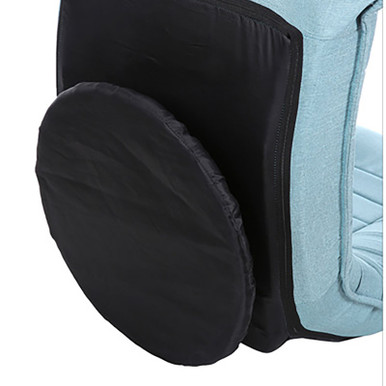
Zuri Linen Rotating Lounge Chair — SGD 280 with free delivery to your doorstep at Linear Furnishings Singapore
Why Swivel Matters: The Design of Spatial Freedom
The rotating function of the Tulip and similar pedestal chairs addresses something that static furniture cannot: the reality that people do not occupy space in fixed orientations. We turn to speak, we rotate toward light, we reposition in response to conversations and sounds.
Static furniture requires the room to be configured to the furniture's fixed orientation. Rotating furniture allows a single chair to serve multiple spatial orientations — a living room chair can face the television for evening viewing and turn toward the window for morning reading without being physically moved.
The Rotating Lounge Chair in Singapore Homes
- Open-plan utility: In Singapore's open-plan HDB and condo interiors, a chair positioned between living and dining areas can participate in either space with a turn
- Visual clarity: The pedestal or star base eliminates the four-leg profile of conventional armchairs — creating meaningful visual space in compact Singapore rooms
- Engagement flexibility: The swivel allows natural conversation orientation without requiring the occupant to perch at the edge of their seat to face a new direction
- Natural linen material: The organic warmth of linen contrasts with the mechanical precision of the swivel base — a material dialogue that references Saarinen's own interest in material contrast
Frequently Asked Questions
How do you maintain a swivel mechanism in Singapore's humidity?
Quality swivel mechanisms require minimal maintenance in normal Singapore conditions. If rotation becomes stiff over time, apply a small amount of silicone-based lubricant to the bearing mechanism. Avoid oil-based lubricants which attract dust and can stain flooring. If lateral wobble develops, check and tighten the base attachment screws — this is typically the cause.
Are rotating lounge chairs stable?
Quality rotating lounge chairs use weighted bases (typically cast aluminium or zinc) that provide significant stability resistance. The low centre of gravity of a lounge chair combined with a wide base diameter ensures stability under normal use. The rotation bearing itself does not compromise stability — it only allows movement in the horizontal plane.
Can a rotating lounge chair be used as a home office chair?
Rotating lounge chairs are designed for relaxed seating — lower seat height, deeper seat, more reclined posture — rather than the active upright posture that extended desk work requires. For occasional video calls or reading, a rotating lounge chair is comfortable. For sustained 8-hour desk work, a dedicated ergonomic office chair provides better postural support.