
Updated May 2025 -- All material specifications verified. Browse our director table range
The surface finish on a director table is not merely aesthetic — it is a protective barrier between the board substrate and the daily assault of humidity, UV radiation, impact, and chemical exposure in a Singapore office environment. Understanding what different finishes actually are, how they are manufactured, and what quality indicators to look for separates furniture buyers who make informed decisions from those who rely on marketing descriptions.
The Surface Finish Hierarchy
| Finish Type | Hardness (Pencil) | VOC | Singapore Durability | Cost |
|---|---|---|---|---|
| NC (Nitrocellulose) | H–1H | High | Poor — yellows quickly | Low |
| PU (Polyurethane) | 2H–4H | Medium | Good | Medium |
| UV (Ultraviolet cure) | 3H–4H | Very low | Good–Excellent | Medium |
| Baked Enamel (烤漆) | H–2H | Medium (during application) | Good | Medium-High |
| Piano Lacquer / PE | 2H–4H | Medium-High (PE) | Excellent | High |
| Water-based | H–2H | Very low | Adequate | Medium-High |
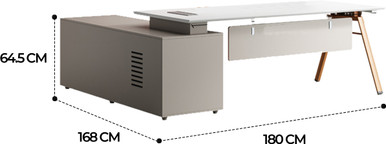
Giulia Directors Table XC 602 -- from SGD 748 with free islandwide delivery to your doorstep at Linear Furnishings Singapore
UV Coating: The Modern Industrial Standard
The Chemistry
UV (ultraviolet) coating is cured by exposing the applied material to high-intensity UV light (wavelength 320–390nm). Photoinitiators in the coating absorb UV energy and generate free radicals, initiating rapid polymerisation of acrylate or epoxy monomers. The entire curing process takes 0.5–3 seconds, enabling production line speeds impossible with air-dried or oven-cured alternatives.
UV coating is not a single product — it is a curing mechanism. UV-curable coatings can be formulated as basecoats, primers, or topcoats, and are combined with other finish systems in various ways depending on the desired result.
Standard UV Production Process
The most common commercial process for panel furniture:
- Board surface sanding (120-grit, then 180-grit)
- Roller application of UV primer — uniform film thickness (machine-controlled)
- UV cure (UV lamp, 0.5–2 seconds)
- Sanding (240-grit) — smoothing for next coat
- Roller application of UV basecoat
- UV cure
- Sanding (320-grit)
- Spray application of PU topcoat — colour and gloss level set here
- Air or heat drying (2–4 hours)
- Quality inspection
PU Lacquer: The Versatile Professional Standard
Chemistry and Formulation
Polyurethane (PU) lacquer is a two-component system: polyol (Component A) and polyisocyanate (Component B), which react when mixed to form cross-linked polyurethane polymer chains. The cross-linked structure — formed through chemical reaction rather than simple solvent evaporation — produces a significantly harder, more durable film than single-component alternatives like nitrocellulose (NC) lacquer.
Process and Parameters
| PU Process Parameter | Standard | Premium | Quality Indicator |
|---|---|---|---|
| Number of basecoats | 2 | 3–4 | More coats = better film build and depth |
| Film thickness per coat | 30–50 μm | 40–60 μm | Thicker = more material for protection |
| Total film thickness | 80–120 μm | 150–200+ μm | Higher total = better long-term protection |
| Sanding between coats | Standard (240-grit) | Premium (320–400-grit) | Finer grit = smoother substrate = better final appearance |
| Topcoat system | Single PU topcoat | PU topcoat + protective clearcoat | Additional clearcoat extends finish life |
| Cure environment | Open shop floor | Temperature/humidity-controlled spray booth | Controlled environment eliminates inclusions and orange peel |
Baked Enamel: The Lacquer Marketing Category
White lacquer director tables — including our Celeste series — use baked enamel in the sense that white PU lacquer is cured in an oven at 80–130°C. The baking process produces a harder, more uniform film than air-dried PU, with better colour stability (white PU lacquer that is air-dried can yellow more readily than oven-cured equivalents).
| Baked Enamel Quality Indicator | Minimum | Good | Premium |
|---|---|---|---|
| Number of application coats | 4 | 6 | 8+ |
| Baking temperature | 80°C | 100°C | 120–130°C |
| Total film thickness | 0.25mm | 0.30mm | 0.35–0.50mm |
| Pencil hardness | HB | H | ≥2H |
| Heat resistance test | 80°C, no whitening | 100°C, no whitening | 100°C, 60 min, no whitening or bubbling |
| Adhesion (cross-cut test) | 3B | 4B | 5B (best) |
Piano Lacquer: What It Actually Is (and What It Is Not)
True piano lacquer uses unsaturated polyester (PE) resin — a three-component system (resin + initiator + accelerator) that produces an extremely thick, high-gloss film with exceptional optical depth. The name derives from its use on concert grand pianos, where mirror-quality finish is required.
The Authentic Piano Lacquer Process
- Raw board preparation and sanding
- Application of sealer coat
- Fill and sand (multiple cycles — each requiring full cure and wet-sanding)
- PE primer application
- Cure, then 240-grit wet sand
- PE basecoat (3–5 applications, each with intermediate wet sanding)
- Colour coat application
- Clearcoat application
- Oven curing
- 800-grit wet sand
- 1200-grit wet sand
- 2000-grit wet sand
- Fine compound polishing
- Total: 20+ steps, minimum 10 days production time
Surface Finish Quality: What to Check in Singapore Showrooms
| Visual Test | Method | Good Result | Problem Indicator |
|---|---|---|---|
| Gloss uniformity | View surface at acute angle under light | Even, consistent sheen | Orange peel texture, patchiness |
| Edge quality | Examine panel edges near handles/corners | Smooth, rounded edges blending into surface | Sharp edges, paint build-up at corners |
| Film adhesion | Flex a sample panel if possible | No cracking at corners | Cracking at panel edges (under-cured film) |
| White clarity (white finishes) | Compare against white reference | Clean white | Yellowing or grey tinge (old stock or poor curing) |
| Scratch test | Fingernail drag on unobvious surface | No visible scratch | Easily scratched (insufficient hardness) |
Frequently Asked Questions
What is the difference between 'baked lacquer' and 'piano lacquer' on a director table?
Baked lacquer is PU lacquer cured in an oven (80–130°C), typically 4–8 coats, producing a hard, durable high-gloss surface. True piano lacquer uses PE resin with 20+ process steps and wet sanding between each, producing a deeper optical depth and higher surface perfection. Most 'piano lacquer' furniture in the market uses PU baked lacquer — adequate for furniture use but not equivalent to the PE process. Ask specifically which system is used.
Does lacquered furniture off-gas VOCs in a Singapore office?
During application, PU lacquer has significant VOC content (solvents in the 400–600g/L range). After curing and drying — which occurs during manufacturing, not after delivery — residual VOC emissions drop dramatically. By the time a lacquered director table is delivered and installed, VOC off-gassing is minimal for quality PU or UV/PU combination finishes. UV-cured finishes have essentially zero residual VOC (no solvents in the UV coating system).
How do I maintain a lacquered director table surface in Singapore?
For all lacquered surfaces: use a slightly damp microfibre cloth for daily wiping — never abrasive cloths or sponges. For spills: wipe immediately — do not leave liquid in contact with lacquered surfaces. Avoid acetone-based cleaners (nail polish remover). For piano lacquer or high-gloss baked enamel: use dedicated furniture polish (containing light abrasives) once monthly to maintain optical clarity and protect against micro-scratches.