
Updated May 2025 -- All material specifications verified. Browse our director table range
The material your director table is made from determines not just its initial appearance, but its performance over 5, 8, and 12 years of daily use in Singapore's tropical conditions. This guide examines every board type used in commercial office furniture manufacturing — from raw material sourcing through to how each performs in Singapore's 75–85% humidity environment.
Why Singapore's Climate Changes Every Material Calculation
Most furniture specifications and marketing claims are developed for European or North American conditions: approximately 20°C and 50–60% relative humidity. Singapore operates at 26–32°C and 75–85% RH — an environment that accelerates virtually every material degradation pathway. The material that performs adequately for 10 years in London may deteriorate in 4 years in a Singapore office.
The single most important principle: moisture is the enemy of all engineered wood products. How well a director table resists moisture infiltration — through its board type, edge sealing, and surface finish — determines its lifespan in Singapore's conditions.
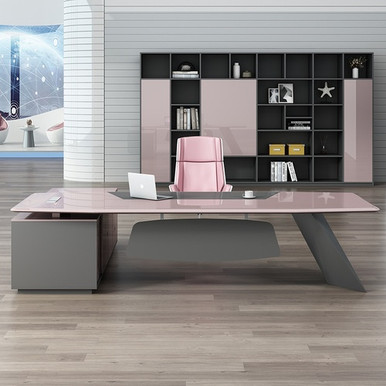
Hugo Lacquer Executive Director Desk -- from SGD 688 with free islandwide delivery to your doorstep at Linear Furnishings Singapore
MDF: Maximum Workability, Maximum Formaldehyde, Minimum Humidity Resistance
Manufacturing Process
MDF (Medium Density Fibreboard) is manufactured by breaking down wood residues into fibres using a refiner at high temperature and pressure, mixing these fibres with urea-formaldehyde (UF) adhesive, forming them into a mat, and hot-pressing at 160–180°C under 2.5–4.5 MPa pressure. The resulting board has the most homogeneous structure of any engineered wood product — which is why it finishes so well.
The problem: MDF uses more adhesive per cubic metre than any other engineered wood product. Approximately 100–150kg of UF resin is used per cubic metre of MDF, compared to 60–90kg for particleboard. More adhesive means more formaldehyde.
| MDF Property | Value | Singapore Implication |
|---|---|---|
| Density | 650–880 kg/m³ | Heavy for its size |
| UF adhesive content | 100–150 kg/m³ | Highest formaldehyde source |
| Surface uniformity | Excellent — best for painting | Why most lacquered desks use MDF panels |
| Moisture expansion (24h) | 8–12% thickness swell | High risk in Singapore's humidity |
| Screw withdrawal force | 400–600N | Weakest engineered wood — stripping risk |
| Machinability | Excellent — routes and profiles cleanly | Preferred for shaped door panels |
Particleboard: The Practical Mid-Range — Quality Depends on Source
Manufacturing and the Three-Layer Structure
Particleboard is manufactured in a three-layer structure: coarse particles in the core layer (lower adhesive content, structural function) and fine particles on the surface layers (higher adhesive content, smooth finish). Understanding this structure explains both its strengths and its limitations.
| Layer | Particle Size | Adhesive Content | Function |
|---|---|---|---|
| Surface layer | Fine (<1mm) | 8–12% by weight | Smooth surface, bonding to laminate |
| Core layer | Coarse (2–8mm) | 3–5% by weight | Structural strength, dimensional stability |
| Surface layer | Fine (<1mm) | 8–12% by weight | Smooth surface, bonding to laminate |
Standard vs Solid Wood Particle Board: The Critical Distinction
Chinese furniture manufacturers distinguish between standard particleboard (which may include recycled content including paper, bagasse, and mixed wood waste) and 实木颗粒板 (solid wood particle board), which uses only particles from solid wood processing with no mixed waste content. The difference matters:
- More consistent density and structure throughout the board
- Lower formaldehyde content (purer UF resin-to-wood ratio)
- Better moisture resistance (no hygroscopic paper or sugar-containing materials)
- Higher screw withdrawal force (more consistent particle sizing)
Premium Chinese brands producing solid wood particleboard include Tubaobao (兔宝宝), Moganshan (莫干山), and EGGER China — these are the suppliers that quality furniture manufacturers specify.
Multi-Layer Plywood: The Structural Choice
Multi-layer plywood (multi-layer solid wood board) is manufactured by bonding odd numbers of solid wood veneers (1.7–4.5mm each) in alternating grain directions using either phenol-formaldehyde (PF) or urea-formaldehyde (UF) adhesive. The cross-ply structure is the key engineering principle: by orienting alternating layers perpendicular to each other, the anisotropic (directionally variable) properties of wood are cancelled out, producing a board with stable, consistent properties in all directions.
| Property | Multi-Layer Plywood | Particleboard | MDF |
|---|---|---|---|
| Moisture resistance | Good — cross-ply structure resists distortion | Poor — swells uniformly | Very poor — swells severely |
| Screw withdrawal | Good — parallel-to-grain layers provide grip | Moderate | Poor |
| Formaldehyde | Lower (less adhesive volume needed) | Medium | Highest |
| Structural strength | High — best for bearing loads | Moderate | Low |
| Surface quality | Slight surface grain — needs sanding | Smooth | Smoothest |
| Cost | Higher | Lower | Medium |
Solid Wood: Zero Formaldehyde, Climate Management Required
Solid wood director tables contain zero formaldehyde from the primary material — the wood itself. But 'solid wood' does not mean 'problem-free in Singapore.' The challenge is managing wood's natural response to moisture variation.
Wood Species and Their Singapore Performance
| Species | Density | Singapore Suitability | Notes |
|---|---|---|---|
| Oak | 700–900 kg/m³ | Good — requires drying and sealing | High-end European and American offices |
| Walnut | 600–700 kg/m³ | Good with treatment | Premium dark colour, executive standard |
| Rubberwood | 650–700 kg/m³ | Very good — naturally dense | Southeast Asian species, handles tropical humidity better |
| Beech | 700–800 kg/m³ | Acceptable | Hard, used for curved/shaped elements |
| Ash | 680–800 kg/m³ | Good | Distinctive grain, flexible for designer pieces |
Sintered Stone: The Zero-Compromise Surface
Sintered stone is manufactured by dry-pressing natural mineral materials (feldspar, silica, clay, natural pigments) under extreme pressure (30,000–50,000 tonnes) and sintering at 1,200–1,250°C. The process replicates in controlled manufacturing conditions the geological formation of natural stone over geological time scales.
| Property | Sintered Stone | Marble | Solid Wood | Engineered Wood (E0) |
|---|---|---|---|---|
| Formaldehyde | Zero | Zero | Zero | Near-zero (≤0.05mg/m³) |
| Water absorption | <0.1% | 0.2–2.0% | 4–12% (untreated) | 8–12% |
| Hardness (Mohs) | 6–7 | 3–5 | 2–4 | 2–3 |
| Heat resistance | >200°C | Cracks under thermal shock | Scorches at ~200°C | Surface damage at ~70°C |
| Scratch resistance | Excellent | Poor | Moderate | Poor |
| Singapore suitability | Excellent — unaffected | Good but maintenance-intensive | Good with treatment | Good with sealing |
Formaldehyde Standards: The Singapore Perspective
Singapore regulates indoor formaldehyde through SS 554:2016 + A1:2021 — the Code of Practice for Indoor Air Quality for Air-Conditioned Buildings. This is the standard Singapore employers must comply with under the Workplace Safety and Health Act. The limit for formaldehyde in air-conditioned office spaces is 0.1 mg/m³ (0.08 ppm) as an 8-hour average.
Singapore does not have its own mandatory board emission classification — instead, the market accepts internationally recognised certifications. The key question for Singapore director table buyers is not which country's production standard was used, but whether the furniture, when installed in a Singapore office, will keep room air below SS 554's 0.1 mg/m³ formaldehyde limit.
| Certification | Formaldehyde Limit | Relation to SS 554:2016 | Singapore Recommendation |
|---|---|---|---|
| CARB Phase 2 (USA) | Particleboard: ≤0.09ppm / MDF: ≤0.11ppm | Within SS 554 safe margin | ✅ Widely recognised — Green Mark buildings |
| GREENGUARD Gold (USA/UL) | Comprehensive VOC limits | Well within SS 554 limits | ✅ Premium — Green Mark & commercial procurement |
| E0 (international) | ≤0.050 mg/m³ | Provides clear margin below 0.1 mg/m³ | ✅ Recommended minimum for Singapore offices |
| ENF (international) | ≤0.025 mg/m³ | Maximum safety margin | ✅✅ Best specification |
| E1 (international) | ≤0.124 mg/m³ | Exceeds SS 554 limit — risk in enclosed offices | ⚠️ Marginal — not recommended |
| No certification | Unknown | Cannot verify SS 554 compliance | ❌ Avoid for Singapore commercial offices |
Upcoming Singapore regulation: The NEA banned formaldehyde in interior paints from January 2026. As of April 2025, the Ministry of Sustainability and Environment confirmed NEA is actively reviewing formaldehyde regulations for composite wood products and furniture adhesives. Singapore director table buyers who specify E0 or better today are ahead of regulations that are coming — not behind them.
Frequently Asked Questions
Why does solid wood director table cost more than engineered board versions?
Solid wood is harvested, kiln-dried, graded, and processed material — it cannot be manufactured to order in the way engineered boards are. Premium solid wood species (walnut, oak) are also slower-growing, making supply constrained. Additionally, solid wood manufacturing requires more precision: wood movement must be accommodated in joinery design, requiring higher craftsmanship standards.
Does a sintered stone top add significantly to the cost of a director table?
Yes — sintered stone material costs are higher than engineered wood surfaces, and the weight requires more substantial structural support. However, the premium is partially offset by the elimination of any future refinishing costs: sintered stone requires no sealing, no reconditioning, and no surface treatment over its lifetime.
How can I tell if a director table marketed as 'solid wood' actually is?
Check the cross-section at a joint or handle attachment point — genuine solid wood shows natural wood grain running continuously through the piece. Engineered wood shows laminate layers or a uniform core material. The weight is also a guide: solid wood is generally heavier per unit volume than particleboard or MDF. Ask the retailer to confirm whether the specification is solid wood throughout or solid wood veneer over engineered core.