
Singapore's furniture retail market is competitive, and the gap between what sofas are marketed as and what they actually contain is sometimes significant. This guide, based on how sofas are actually manufactured and what the technical standards mean, exposes the most common misleading claims — and gives you the specific questions to ask before you spend SGD 1,500-5,000 on a sofa.
Lie #1: 'Genuine Leather' on Budget Sofas
The term 'genuine leather' is technically accurate — the material is real leather. But in the leather industry, 'genuine' indicates the lowest grade of real leather: the inner split layers of the hide, where fibre structure is weakest. More critically, many sofas marketed as 'leather' in Singapore below SGD 1,500 are actually bonded leather — a material containing only 10-20% leather fibre, mixed with polyurethane adhesive and pressed onto paper backing.
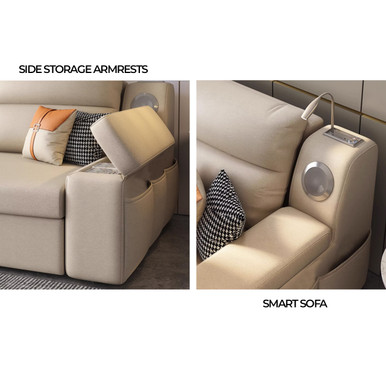
Mia Wooden Sofa Bed with Charging Station and Bluetooth Modern Style -- from SGD 1888.9 with free islandwide delivery at Linear Furnishings Singapore
Updated May 2025 -- Browse our sofa bed range
Lie #2: 'High-Density Foam' Without Numbers
Every sofa retailer claims 'high-density foam.' There is no regulated definition of 'high-density' — each manufacturer defines it as they choose. A chair marketed as 'high-density foam' at SGD 800 may use 1.5 lb/ft³ foam (which sags within a year) while one at SGD 1,800 may use genuine 2.5 lb/ft³ HR foam that maintains its shape for a decade.
The question that separates real answers from marketing: 'Can you give me the foam density in lb/ft³ or kg/m³?' A retailer selling quality foam knows this number. A retailer selling budget foam will deflect with phrases like 'very high quality' or 'tested to international standards.'
Lie #3: 'Italian Leather' or 'Top-Grain Italian Leather'
'Italian leather' describes where the tanning occurred, not the hide quality or construction. Italy is a respected tanning centre, but leather tanned in Italy ranges from premium full-grain to split leather. 'Italian leather' without specifying the grade (full-grain, top-grain, or split) is a geographic claim, not a quality claim.
Lie #4: 'Solid Wood Frame' on MDF/Particleboard Furniture
Some furniture uses solid wood legs and decorative elements while using MDF or particleboard for the main frame structure. This can be accurately described as having 'solid wood elements' — but the critical load-bearing structure is engineered board, which absorbs moisture, expands, and loses screw-grip in Singapore's conditions.
The specific question: 'Are all the structural load-bearing frame members — the main rails, the seat frame, the back frame — solid wood? Or just the legs?'
Lie #5: '10-Year Warranty' That Covers Nothing You Care About
| Warranty Component | What Budget Warranties Cover | What You Actually Need |
|---|---|---|
| Frame structure | ✅ Usually covered | Minor value — frames rarely fail first |
| Seat cushion foam | ❌ Almost never covered | Critical — foam sags first |
| Fabric | ❌ Almost never covered | Important — fabric shows wear most visibly |
| Spring system | ✅ Sometimes covered | Important for long-term comfort |
| Legs and hardware | ✅ Usually covered | Minor — these rarely fail |
A warranty that covers only the frame while excluding foam and fabric is a marketing tool. Ask: 'Does this warranty cover the seat cushion foam and the upholstery fabric?'
Lie #6: 'Anti-Stain/Stain-Resistant Fabric'
Two very different things use the same description:
- Performance fabric (permanent protection): Engineered from the fibre level — the fabric itself repels liquids. This protection does not diminish with use or washing.
- Stain-guard spray (temporary protection): A surface coating applied after manufacture. Feels similar to performance fabric initially. Degrades with use and cleaning, typically losing effectiveness within 2-3 years.
The question: 'Is the stain resistance built into the fibre construction (performance fabric) or is it a surface spray treatment?' These are fundamentally different products at the same price.
Lie #7: 'Spring Sofa' When It Has Elastic Webbing
Elastic webbing is a legitimate suspension system for lightweight, design-forward sofas. But when a retailer says 'spring system' and means rubber webbing, the expected durability is very different from a sinuous spring or coil spring sofa. Rubber webbing loses elasticity within 3-7 years; springs maintain their performance for 10-15+ years.
Ask: 'What type of suspension system? Is it coil springs, sinuous springs, or elastic/rubber webbing?'
Lie #8: 'Down-Filled Cushions' as Luxury Claim
True goose down is expensive and uncommon in mid-range sofas. 'Down alternative,' 'down-feel,' or polyester fiberfill presented alongside down imagery misleads buyers into expecting the comfort and lifespan of real down. Ask: 'Is this genuine duck or goose down, or polyester fiberfill marketed as down-alternative?'
Lie #9: 'Eco-Friendly / Sustainable / Natural Materials'
Without certification (FSC for wood, GREENGUARD or Oeko-Tex for materials, organic certification for natural fibres), these are marketing terms with no verifiable meaning. Ask for the specific certification and verify it is current and from an accredited body.
Lie #10: Price as a Proxy for Quality
Price correlates imperfectly with quality in Singapore's furniture market. Some mid-range retailers charge premium prices for mediocre construction. Some specialist importers offer genuinely quality sofas at competitive prices because of lower overhead. The questions in this guide — frame material, foam density, spring type, fabric Martindale count — provide a quality assessment that price alone cannot.
Frequently Asked Questions
How do I tell if a sofa has bonded leather or genuine leather?
Ask directly: 'Is this bonded leather or top-grain genuine leather?' Bonded leather has a perfectly uniform, embossed texture with no natural grain variation — it looks 'too perfect.' Genuine leather has slight natural variation. If the sofa is priced below SGD 1,200 and marketed as leather, bonded leather or PU leather is almost certain. In Singapore, bonded leather sofas typically begin peeling visibly within 12-18 months.
What questions should I ask before buying a sofa in Singapore?
The five most important: (1) Frame material — kiln-dried hardwood or rubberwood? (2) Seat foam density — specific number in lb/ft³ or kg/m³? (3) Spring system — sinuous springs, coil springs, or elastic webbing? (4) Fabric — what is the Martindale count? (5) Warranty — does it cover foam and fabric, or only the frame?
Is it worth paying more for a quality sofa in Singapore?
Yes, strongly. A SGD 800 sofa that needs replacing every 3 years costs SGD 267/year over a decade. A SGD 2,500 sofa with kiln-dried hardwood frame, high-density foam, and quality sinuous springs that lasts 12 years costs SGD 208/year — and provides significantly better comfort throughout. The quality investment is recovered in 3-5 years and then provides positive return.